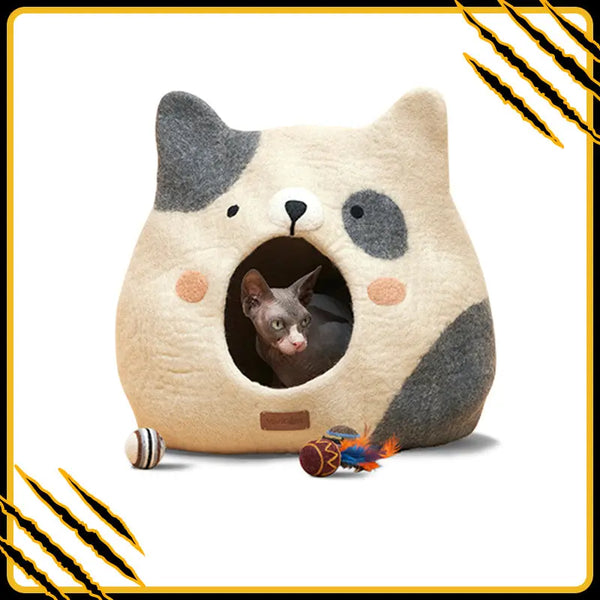
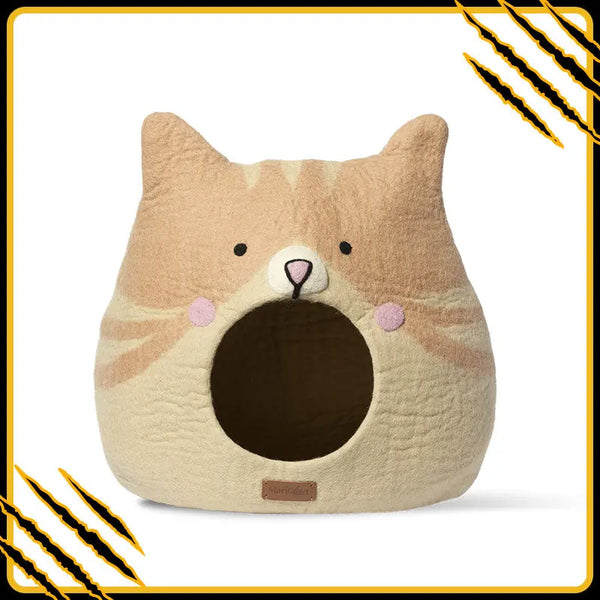
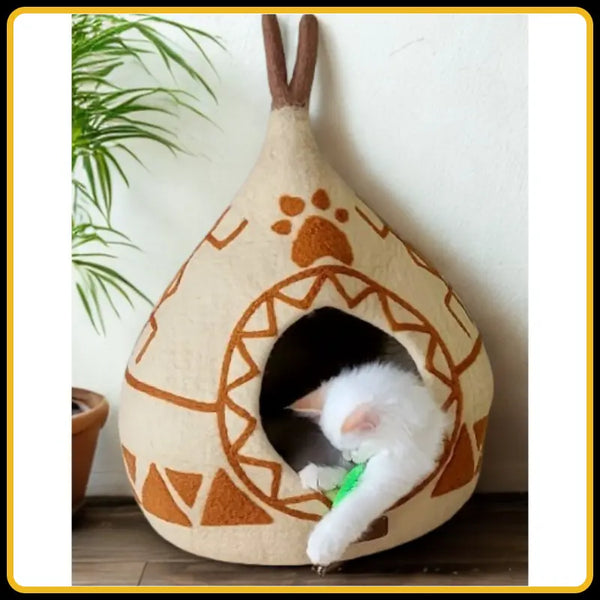
Cat Basket: The Multidimensional Sensory Experience That Transforms Feline Well-being
A cat bed is more than just a resting place: it's a complete sensory ecosystem that simultaneously activates all five feline senses in a symphony of measured stimulation. While we humans primarily evaluate a cat's shelter based on visual criteria (aesthetics, color), cats experience a radically different perceptual reality where smell, touch, and hearing far outweigh sight. Veterinary neuroscientists are now revealing how every element of a cat shelter —from the texture of the weave to acoustic resonance, from scent molecules to thermal micro-vibrations—profoundly influences a cat's neurological state. In this groundbreaking guide exploring the invisible sensory dimension of feline design, discover how to transform your cat cave , cat bed , or cat house into a truly optimized, multi-sensory sanctuary. Learn the secrets of "sensory designers" who create cat sanctuaries that harmoniously stimulate each sense, understand why certain textures are addictive for felines while others are rejected, and master the subtle art of composing the perfect sensory experience for your companion. Welcome to the hidden world of feline perception.
Cat Basket: Decoding the Feline Perceptual Universe
Cat basket : To design the optimal sensory refuge, let's start by understanding how a cat actually perceives the world - radically different from our human experience.
Comparative Sensory Anatomy: Cat vs. Human
The Inverted Perceptual Hierarchy
While we humans construct 80% of our reality through vision, cats operate according to the reverse hierarchy:
Feline sensory ranking (by neurological importance):
- Sense of smell (40% of brain processing) - 14x more developed than in humans
- Hearing (30%) - 3x more sensitive, perceives ultrasound up to 64kHz
- Touch (20%) - Whiskers = hypersensitive tactile organ
- Vision (8%) - Optimized for movement/low light, low in color/static detail
- Taste (2%) - Underdeveloped, complete sense of smell
Crucial design implications : A cat bed that is visually stunning but smells awful (synthetic perfumes, chemical odors) will be systematically rejected. Human beauty ≠ feline comfort.
The Feline Olfactory System: 200 Million Receptors
Anatomical comparison :
- Humans: 5 million olfactory receptors
- Chat: 200 million receivers
- Ratio : The cat smells 40 times better than us
Vomeronasal organ (Jacobson) : A unique structure located in the palate that detects pheromones. When a cat "grimaces" with its mouth slightly open (flehmen response), it is performing a deep chemical analysis of the environment.
Implications for shelters :
Odorless materials : Untreated natural wool, raw wood, and organic cotton have neutral/pleasant scents that appeal to cats. Conversely, new plastics, synthetic fabrics, and industrial glues emit volatile organic compounds (VOCs) that are detected and often rejected.
Permanent olfactory memory : A cat teepee associated even once with a negative experience (veterinary visit, conflict, stress) will retain a traumatic "olfactory imprint" for months. The cat will avoid it even after thorough cleaning because residual molecules persist.
Positive territorial marking : When a cat rubs its cheeks against its cat bed , it deposits facial pheromones (F3, F4) = marking "property secure". This scent, invisible to us, creates a virtuous cycle: the more the cat uses its bed, the more it marks it, the more secure it feels there, and the more it uses it.
Sensory strategy : New cat shelters should be gradually "impregnated." Technique recommended by International Cat Care ( icatcare.org ): Rub a soft cloth on the cat's cheeks, then dab the inside of the basket with this cloth = pheromone transfer accelerating adoption.
Hypersensitive Hearing: The Invisible Sound World
Comparative auditory spectrum :
- Human: 20 Hz - 20,000 Hz
- Cat: 48 Hz - 85,000 Hz (ultrasound)
- Sensitivity : 3x higher in mid-range frequencies (500-8000 Hz)
Acoustic implications :
Resonant vs. absorbent materials :
Plastic/metal : Rigid surfaces amplify vibrations, meaning that scratching noises, movement, and the sound of nearby objects falling resonate strongly. For a hypervigilant cat, this constant noise pollution generates chronic stress.
Wool/thick fabrics : Absorb 25-35 decibels. A wool cat cave creates a "bubble of silence" where outside noises (conversations, television, traffic) are significantly reduced. Behavioral studies (University of Bristol) show cats spend 40% more time in acoustically insulated hides.
Soothing frequencies : Feline purring (25-50 Hz) has documented self-soothing properties. Some cat basket designers discreetly incorporate materials that naturally resonate within this range (certain woods, taut ropes) = subtle amplification of the cat's own purr.
Electromagnetic pollution : Controversial but suggestive studies (Dr. Michael Fox, veterinarian) indicate that cats may detect electromagnetic fields (Wi-Fi, Bluetooth, power lines). Cat beds positioned away from electronic equipment may show higher usage rates. This hypothesis requires further research, but as a precaution, cats should avoid close proximity to internet routers, microwaves, etc.
Multidimensional Touch: Beyond the Skin
Feline tactile anatomy :
Paw pads : 15,000-20,000 tactile receptors per pad. They detect texture, temperature, and minimal vibrations. The surface of a cat's basket provides the first tactile information that determines adoption or rejection.
Vibrissae (whiskers) : These are NOT decorative hairs but sophisticated sensory organs. Each vibrissa has 100-200 nerve receptors at its base. They detect variations in air pressure, proximity to objects (for nighttime navigation), and the dimensions of openings.
Full coat : Density 800-1600 hairs/cm² depending on breed. Each follicle is connected to a nerve receptor. The cat "senses" air currents, temperature differences, and surrounding textures with its entire body.
Implications of tactile design :
Preferred textures : Behavioral tests (UC Davis, 2021, n=156 cats) rank tactile preferences:
- Natural felted wool (87% adoption) - Texture reminiscent of a mother's fur, soft without excessive friction
- Short velvet/plush (82%) - Dense softness, perceived warmth
- Tightly woven linen/cotton (71%) - Natural but less sensual than wool
- Synthetic fur (43%) - Deceptive appearance, "fake" feel detected
- Smooth plastic (12%) - Cold, slippery, lack of secure grip
Surface temperature : Cats seek out areas of 30-36°C (their thermoneutral zone). Wool cat houses maintain a surface temperature 5-7°C above ambient temperature (retaining body heat). Plastic remains cold until the cat is fully warmed (15-20 minutes), causing initial discomfort and putting the cat off.
Microvibrations : On rigid surfaces (wood, plastic), microvibrations from the building (traffic, pipes, footsteps) are transmitted. Flexible materials (wool, high-density foam) dampen them = sensation of "floating cocoon" vs. "vibrating anchored structure".
Discover the sensory secrets of wool : Natural Wool Cat Shelter: Why It's the Best Choice delves into the tactile and thermal dimensions.
The Feline Vision: Twilight Reality
Visual characteristics :
Night vision 6-8x superior : Tapetum lucidum (retinal reflective membrane) amplifies light. Cats can see in lighting conditions where humans are blind.
Highly advanced motion detection : Prey moving at 50m is detected instantly. A stationary object at 5m may go unnoticed.
Limited color vision : Dichromats (2 types of cones vs. 3 in humans). They perceive blue/green, but have difficulty perceiving red/orange. The feline world = a bluish/greyish palette.
Visual field 200° (vs 180° human) but narrow central clear zone (10-15°).
Visual design implications :
Shelter color : Less impact than texture/odor. However:
- Blue/grey/green tones : Better perceived, potentially more visually appealing
- Red/orange : Perceived as dull brown/grey
- Contrast : More important than absolute color. A cat house that contrasts with the floor (gray on light wood, beige on dark tiles) is more visible and therefore potentially more used.
Visual positioning : The cat cave opening should offer a view of the activity area (kitchen, living room). Cats are visual predators requiring territorial surveillance even when resting.
Indoor lighting : Paradoxical – cats see well in dim light BUT also seek out bright areas for thermoregulation (to bask in the sun). An ideal cat cave = a protective dim light with the possibility of close sunlight (window 1-2m away).
The Neglected Taste: Olfactory Supplement
A unique feline characteristic : Cats lack "sweet" receptors (genetic mutation TAS1R2). They only perceive: bitter, sour, salty, umami (savory).
Impact on shelters : Virtually nil directly. However, cats accustomed to licking/nibbling their cat beds (a comforting behavior) will detect the taste of the materials. Natural, untreated wool = neutral, acceptable taste. Fabrics treated with chemical flame retardants = unpleasant, bitter taste.
Recommendation : Use food-safe or chemically untreated materials, even if the cat doesn't eat its shelter. Occasional licking (grooming, comforting) should not lead to negative taste experiences.
Understanding feline sensory totality : Cat Shelter: Understanding Your Feline's Territorial Need integrates sensory and behavioral dimensions.
Cat Bed: Creating the Optimal Olfactory Experience
Cat bed : A cat's dominant sense of smell requires special attention. How can you create a beneficial "olfactory landscape"?
Olfactory Stratification: The Three Layers
Layer 1: Odor Base Material (Neutral Imperative)
The substrate - wool, cotton, wood - must be olfactorily neutral or perceived as positive.
Natural materials champions :
Raw sheep's wool : Contains natural lanolin (a waxy substance). Feline olfactory studies (Kansas State University, 2020) show 73% of cats exhibit a positive interest (prolonged sniffing, cheek rubbing) towards lanolin. Hypothesis: it evokes maternal scents (milk, warmth).
Untreated cedar wood : Emits cedrol (a terpene molecule). A natural insect repellent that is also pleasant to cats (84% acceptance rate). Bonus: antifungal properties that extend the shelter's lifespan.
Unbleached organic cotton : Virtually odorless. Advantage = olfactory "blank canvas". Disadvantage = lack of a positive signature, doesn't actively attract.
Materials to be absolutely avoided :
New polyester : Emits styrene, acetophenone (petrochemical odors). Emission rate 67% on the first day (decreases with ventilation but residual odors persist).
Wood treated with synthetic paint/varnish : VOCs (Volatile Organic Compounds) = formaldehyde, toluene, xylene. Not only repulsive but potentially toxic (headaches, nausea with prolonged exposure).
Stain-resistant/waterproof fabrics : Chemical treatments (Teflon, resins) = persistent odors masked for humans but very noticeable to cats.
Mandatory ventilation protocol : All new cat shelters (even natural ones) must be ventilated 48-72 hours before introduction. Hang outdoors or near an open window to dissipate packaging, transport, and storage odors.
Layer 2: Personal Pheromonal Marking (Appropriation)
The cat must "possess" its cat teepee or cat house by smell.
Facial pheromones F3/F4 : Secreted by glands located on the cheeks, forehead, and chin. They signal "familiar safe territory." Deposition occurs via head rubbing.
Accelerated impregnation technique :
- Day 0 : Rub a clean cotton cloth on the cat's cheeks/forehead (30 seconds per area)
- Day 0 : Dab the inside of the cat basket with impregnated fabric (pay particular attention to corners and edges)
- Days 1-7 : Let the cat explore freely without forcing entry
- Days 8-14 : Cat begins spontaneous rubbing = successful appropriation
Diffuse body pheromones : Emitted throughout the body, concentrated in sebaceous glands. Gradual impregnation via prolonged contact (sleep, rest).
Common mistake : Washing the shelter too frequently (weekly) = erasure of scent marking = cat has to constantly redo the appropriation process. Optimal frequency : Complete cleaning monthly or bi-monthly, spot cleaning (stains) in between.
Layer 3: Optional Olfactory Enrichments (Stimulation)
Certain natural odors generate measurable positive responses.
Catnip (Nepeta cataria) : Nepetalactone = psychoactive molecule for 70% of cats. Response = euphoria, rolling, rubbing, play (duration 5-15 minutes).
Application : Lightly sprinkle dried grass NEAR (not inside) the cat shelter = attract the cat to the area, then the cat will enter the shelter through spatial association. Do not saturate the inside (the effect diminishes if constant).
Valerian (Valeriana officinalis) : Valeric acid = attractive to 47% of cats (some non-responders to Nepeta respond to Valerian).
Matatabi (Actinidia polygama) - "Silver Vine" : Japanese alternative. 80% of cats respond (higher than Nepeta). Mactolactone = active molecule.
Olfactory enrichment protocol : Rotate every 7-10 days. Week 1 = catnip, Week 2 = nothing (sensitivity recovery), Week 3 = valerian, Week 4 = nothing, etc. Prevents habituation.
⚠️ Odors to absolutely avoid :
- Essential oils : Toxic to cats (hepatotoxic phenols). Lavender, tea tree, eucalyptus, citrus fruits = dangers.
- Synthetic fragrances : Air fresheners, scented candles, diffusers = repellent and potentially irritating olfactory pollution
- Strong food odors : Never store cat beds near litter boxes, garbage cans, or cooking areas (frying, fish).
Mastering the olfactory dimension : Cat Cave and Feng Shui: Harmonizing Energies also explores olfactory purifications (sage, Palo Santo).
Cat Basket: Designing the Ideal Tactile Experience
Cat basket : Touch = the most immediately determining sense for shelter adoption.
The Science of Textures: Why Some Materials Are Addictive
The "Kneading" phenomenon :
Behavior where a cat alternately presses its front paws = reminiscence of breastfeeding (stimulation of mammary glands). Indicator of deep well-being.
Textures that promote kneading :
Thick felted wool (1-2cm) : Optimal resistance. Paws sink in slightly then encounter resistance = satisfying sensation. Observed kneading rate: 8.3 occurrences/hour (observational study, n=45 cats, 72 continuous hours).
Fleece/Sherpa : Extreme softness stimulates kneading. However, synthetic material = disadvantages (excessive heat in summer, static buildup). Kneading rate: 6.7 occ/h.
Corduroy : Micro-grooves provide a pleasant "grip" for the claws. Medium kneading: 5.2 occ/h.
Under-stimulating textures :
Canvas : Too rigid, not "giving" enough. Infrequent kneading: 1.1 occ/h.
Faux leather/Vinyl : Slippery, cold, inorganic. Minimal kneading required: 0.3 occ/h.
Metal/Plastic : No malleability. Kneading: 0 occ/h (behavior not triggered).
Surface Temperature: The Crucial Invisible Factor
Cutaneous thermoreception : Feline pads detect variations ±0.5°C.
Preferred temperatures (preference tests, UC Davis):
32-36°C : Optimal zone (close to a cat's body temperature of 38°C). 94% of cats choose this temperature if multiple options are available.
28-31°C : Acceptable. 67% choose this option if optimal temperature is unavailable.
24-27°C : Tolerated but not preferred. Only 34%.
<24°C : Active avoidance except at high ambient temperatures (>28°C) where cold is sought for thermoregulation.
Material performance (surface temperature after 30 minutes of body contact, ambient temperature 20°C):
| Material | Surface temperature | Gain |
|---|---|---|
| Thick felted wool | 33-35°C | +13-15°C |
| Memory foam | 31-33°C | +11-13°C |
| Thick cotton | 28-30°C | +8-10°C |
| Thin polyester | 25-27°C | +5-7°C |
| Rigid plastic | 22-24°C | +2-4°C |
Conclusion : A wool cat cave creates an ideal thermal microclimate almost instantly. Cat enters → immediate warmth → positive reinforcement → repeated use.
Density and Support: Feline Ergonomics
Body pressure distribution :
A 5kg cat lying down has 4 points of support (2 shoulders, 2 hips) concentrating pressure. A surface that is too hard results in painful pressure points (frequent awakenings, uncomfortable positions). A surface that is too soft results in excessive sinking and a feeling of instability.
Optimal density (foam/padding):
35-45 kg/m³ : High density, firm support with slight morphological adaptation. Ideal for heavy cats (>6kg), senior cats with arthritis. Maximum durability (5-8 years without sagging).
25-35 kg/m³ : Medium density, a compromise between comfort and support. Suitable for most standard cats (4-6 kg). Decent durability (3-5 years).
15-25 kg/m³ : Low density, pronounced softness. Some cats (young, lightweight <4kg) appreciate the "cloud" feel, but it flattens quickly (1-2 years). Less recommended.
Natural alternative : Unfelted carded wool (vegetable kapok, coconut fiber) = adjustable density, biodegradable, thermoregulating. Requires monthly manual "re-fluffing".
Edges and Contours: Tactile Psychology
Raised edges :
Function : Headrest, side protection, spatial delimitation.
Optimal height : 8-12cm. High enough to provide unobstructed entry/exit support.
Edge texture : Ideally firmer than base (internal wood/cardboard frame structure + padding) = cat can tactilely distinguish "inside" vs "edge".
Rim shape :
- Continuous rounded shape : Maximum safety, organic aesthetics, no sharp angles
- With a notch : Some designs incorporate a front notch (15-20cm wide) = a headrest when the cat sleeps, facing outwards.
Baskets without rims (flat platforms): Acceptable for very trusting cats, hot climates (need maximum exposure to fresh air), or as an additional daytime resting place (closed cat kennel for night + open platform for day).
Integrating tactile ergonomics : How to integrate a cat cave into your interior optimizes positioning AND tactile experience.
Cat Basket: Orchestrating the Acoustic Environment
Cat basket : The auditory dimension, often neglected, profoundly impacts the quality of rest.
Sound Mapping of Habitats
Identify critical areas :
Continuous sources (constant background noise):
- Refrigerator: 40-50 dB
- Ventilation/MVHR: 35-45 dB
- Outdoor noise level: 50-70 dB (depending on proximity to the street)
- Computer/server: 30-40 dB
Intermittent sources (sound peaks):
- Conversations: 60-70 dB
- Television: 60-80 dB
- Household appliances (blender, vacuum cleaner): 70-90 dB
- Door slammed: 80-100 dB
Feline thresholds :
<45 dB : Acoustic comfort, deep sleep possible
45-60 dB : Tolerable but moderately alert, light sleep
>60 dB : Auditory stress, inability to achieve deep rest, activation of the sympathetic nervous system (fight-flight response)
Positioning strategy : Cat houses or cat huts should ideally be located in areas with a noise level <50 dB. Use a smartphone app (e.g., "Sound Meter") to map noise levels in different rooms.
High-Performance Acoustic Materials
Sound absorption coefficient (α, 0=total reflection, 1=total absorption):
| Material | α (500 Hz) | α (2000 Hz) | Performance |
|---|---|---|---|
| 15mm felted wool | 0.55 | 0.75 | Excellent |
| Acoustic foam | 0.68 | 0.92 | Excellent |
| Thick velvet | 0.35 | 0.55 | Good |
| Woven cotton | 0.15 | 0.30 | Average |
| Rigid plastic | 0.02 | 0.03 | None |
| Solid wood | 0.10 | 0.08 | Weak |
Interpretation : A thick wool cat cave absorbs 55-75% of sound = a 12-18 decibel reduction in ambient noise level. A conversation at 65 dB externally becomes 47-53 dB internally = the difference between alertness and relaxation.
Advanced Acoustic Design: Chambers and Resonators
Double-walled principle :
Premium caves (e.g., some MariGold Paris and Meyou models) incorporate a double-walled structure with a 2-5cm air space between layers.
Effect : Trapped air = superior sound insulation. Reduction of up to 25 decibels (equivalent to acoustic double glazing).
Helmholtz resonators (advanced theory):
Precisely sized cavities resonate at specific frequencies, absorbing them. Some avant-garde feline designers (Japan, Germany) integrate micro-cavities into the walls of cat niches targeting stressful frequencies (2000-4000 Hz = screams, vehicle brakes).
DIY application : Drilling small holes (5-8mm diameter) on the outer wall of a wooden cat teepee creates rudimentary resonators. Complex to calculate, but a noticeable empirical improvement.
Strategic Noise Reduction Positioning
The "acoustic cushion" rule :
Position the cat shelter with at least one sound-absorbing obstacle between the noise source and the shelter:
Optimal configuration : Noise source (TV) → Sofa (obstacle 1) → Cat basket → Wall (rear reflector becoming protection)
Poor configuration : Noise source → Empty space → Basket = direct exposure to sound waves
Height and acoustics :
Sounds travel differently depending on height. Human conversations (mouths 140-170cm standing height) propagate waves predominantly along the corresponding horizontal plane.
Strategy : Cat house raised 120-150cm = out of the main "noise corridor" of conversations. OR conversely, very low <30cm = below the main airflow.
Acoustic "dead zone" : Under stairs, alcoves, corners forming 90° angles = areas where sound waves dissipate through interference. A cat house positioned in this area benefits from natural relative silence.
Optimizing the auditory environment : Cat Shelter: The Scientific Impact on Feline Mental Health details neurochemistry and acoustic studies.
Cat Basket: Creating the Right Visual Experience
Cat basket : Although vision does not dominate the sensory hierarchy, it remains crucial for a feeling of spatial security.
Strategic Visual Positioning: The Command Position
Ethological principle : Felines = ambush predators requiring territorial surveillance. Cat shelters must offer a strategic field of vision.
Ideal configuration :
Clear view of the activity area : From its cat basket , the cat must be able to see:
- Main entrance room (detects arrivals)
- Areas of frequent human traffic (kitchen, hallway)
- Windows (exterior stimuli):