Natural Wool Cat Shelter: Why It's the Best Choice for Your Feline
Choosing a cat shelter made of natural wool is more than just an aesthetic decision: it's opting for a material with exceptional properties that radically transforms the comfort and health of your feline companion. While the market is flooded with cat houses made of plastic, synthetic fabrics, and other industrial materials, natural wool stands out with its unique biological, thermal, and sensory advantages. In this comprehensive guide, discover why cat caves, houses, teepees, and baskets made of handcrafted felted wool surpass all other materials, and how to choose the perfect wool accessory for your cat.
Natural Wool: An Ancient Material with Extraordinary Properties
What is Felted Wool and How Is It Made?
The felted wool used in high-end cat shelters comes from a centuries-old artisanal process. Unlike woven or knitted fabrics, felting exploits a unique property of wool fibers: their ability to grip and interlock permanently under the effects of heat, moisture, and friction.
The artisanal manufacturing process : Artisans begin with raw sheep's wool, meticulously washing it to remove natural impurities, then carding it to align the fibers. Next comes the crucial felting stage: the fibers are laid in cross-layered sheets, moistened with warm soapy water, and then worked by hand for several hours. The friction causes the microscopic scales of the fibers to cling to one another, creating a dense, compact, and extremely durable textile.
What distinguishes a handcrafted wool cat cave from a mass-produced one? The thickness of the felt (generally 4-8 mm for a quality product), the density of the fibers (over 400g/m² for optimal insulation), and above all, the complete absence of glues, resins, or chemical binders. The felt holds together solely through the natural interlocking of the fibers.
The 7 Unique Properties of Wool That Benefit Cats
1. Intelligent Thermoregulation: Cool in Summer, Warm in Winter
Wool possesses exceptional thermoregulatory properties that few materials can match. Wool fibers naturally contain millions of microscopic air pockets that act as dynamic insulation. In winter, these pockets trap the air warmed by the cat's body, creating an effective thermal barrier. A wool cat house maintains an internal temperature 5-8°C higher than the ambient air without any external heat source.
But here's what makes wool truly unique: in summer, this same material wicks away excess heat and moisture, keeping the inside of a natural wool cat house remarkably cool. How? Wool fibers can absorb up to 30% of their weight in moisture without ever feeling wet, then gradually release that moisture, creating a natural evaporative cooling effect.
Thermal comparison :
- Plastic shelter: internal temperature variation of +/- 15°C depending on the outside temperature
- Single-walled wooden shelter: variation of +/- 10°C
- Shelter made of felted wool: variation of only +/- 3-4°C
2. Absorbs and Regulates Moisture Without Feeling Clammy
Cats hate humidity. A damp environment not only promotes joint and respiratory problems, but also deeply stresses felines, who are particularly sensitive to it. Wool brilliantly solves this problem thanks to its hygroscopic structure.
A wool cat cave can absorb moisture from feline respiration, nighttime condensation, or even a small leak without ever feeling damp. The fibers absorb water vapor, retain it within their internal structure, and then gradually release it to the outside as the surrounding air dries. As a result, the inside of a wool cat cave remains dry to the touch, even in humid conditions.
A major hygienic advantage : This moisture management naturally inhibits the growth of mold, fungi, and bacteria that thrive in humid environments. Synthetic fabrics (polyester, nylon) retain moisture on the surface, creating a breeding ground for bacteria.
3. Natural Antibacterial and Odor-Fighting Properties
Lanolin, the waxy substance naturally present in wool even after processing, has scientifically documented antibacterial properties. Microbiological studies have shown that odor-causing bacteria (notably E. coli and Staphylococcus aureus) grow 100 times slower on wool than on polyester.
For your cat, this means that a natural wool cat bed stays fresh and odor-free much longer than a synthetic one. Owners of multiple cats particularly notice this difference: where a synthetic fabric cat bed develops an unpleasant odor after 2-3 weeks, a wool cat bed can remain neutral for 2-3 months with minimal maintenance.
4. Fire Resistance and Safety
Contrary to popular belief, wool is naturally flame-resistant. It only ignites at very high temperatures (570-600°C) and self-extinguishes as soon as the heat source is removed. Synthetic fibers melt and burn easily, releasing dangerous toxic fumes.
For a cat shelter placed near a radiator, fireplace, or on a sunny balcony, this property offers unparalleled security. European fire resistance tests classify wool as category B2 (flame-resistant), while most synthetic fabrics are classified as C or D (flame-resistant).
5. Soundproofing: A Silent Refuge
Cats have exceptionally well-developed hearing, capable of perceiving frequencies up to 64,000 Hz (compared to 20,000 Hz for humans). This auditory hypersensitivity makes them vulnerable to noise stress in our noisy urban environments.
The dense, fibrous structure of felted wool effectively absorbs sound waves, reducing ambient noise by 20-30 decibels inside a wool cat house. This is the equivalent of moving from a busy office environment to a quiet library. For an anxious or elderly cat, this bubble of silence makes a significant difference to the quality of its rest.
6. Elasticity and Resilience: A Shape That Lasts
Have you ever bought a fabric cat bed that loses its shape after a few weeks? Felted wool has remarkable shape memory thanks to the natural spiral structure of its fibers. Even after years of heavy use, a quality wool cat cave retains its original shape.
This elasticity also means the wool adapts to the cat's body, creating an ergonomic sleeping surface that conforms to its contours. Cats suffering from arthritis or joint problems particularly benefit from this adaptive support, which evenly distributes body pressure.
Comparative durability :
- Synthetic fabric basket: 1-2 years before sagging
- Foam basket: 2-3 years before losing firmness
- Handcrafted felted wool cave: 8-15 years with minimal maintenance
7. Soothing and Familiar Natural Texture
Cats possess millions of highly sensitive tactile receptors, particularly concentrated in their paw pads, muzzle, and at the base of their whiskers. The soft yet slightly textured felted wool pleasantly stimulates these receptors without overstimulating them.
Most importantly, wool instinctively evokes the texture of a mother's fur. This subconscious association triggers the release of endorphins and oxytocin (feel-good hormones), explaining why so many cats spontaneously develop a kneading behavior (reminiscent of nursing) on wool surfaces. This behavior is a direct indicator of deep relaxation and feline happiness.
Woolen Cat Cave: The Ultimate Refuge
Why the Cave Shape is Psychologically Ideal
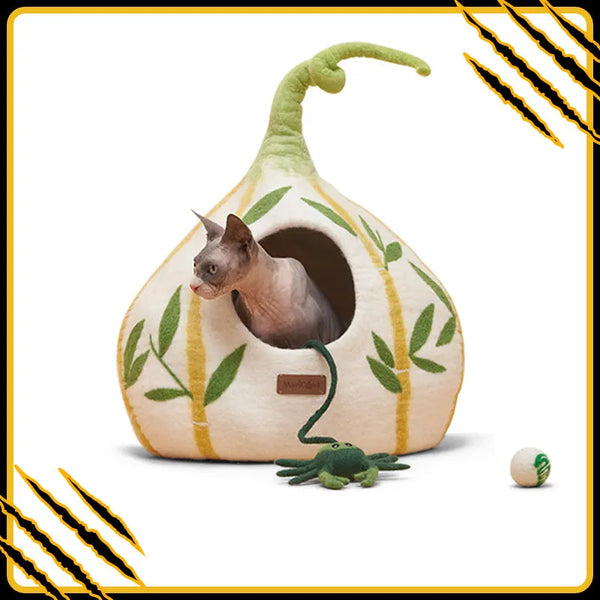
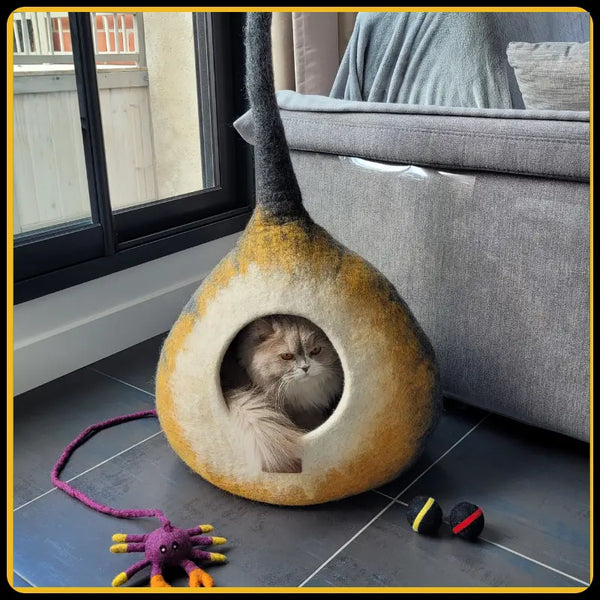
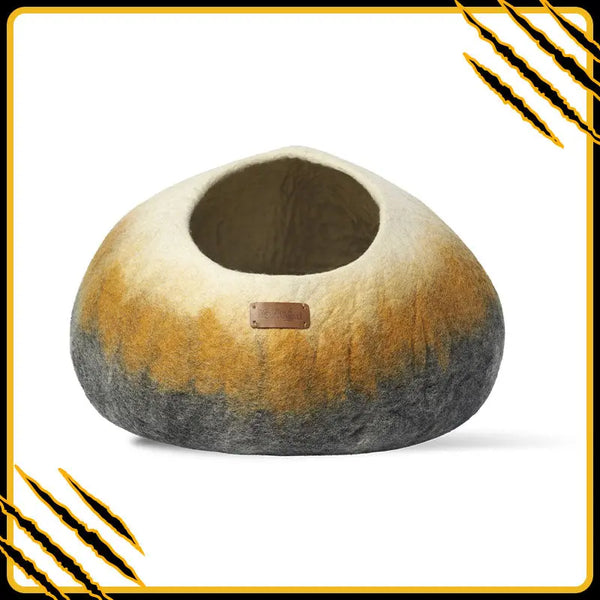
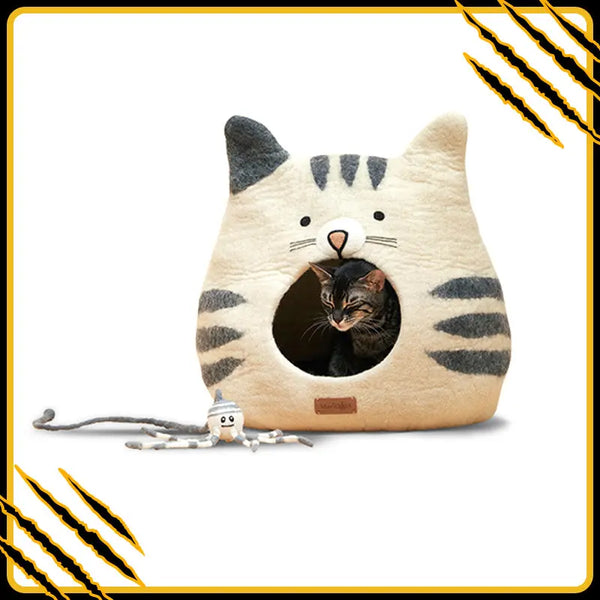
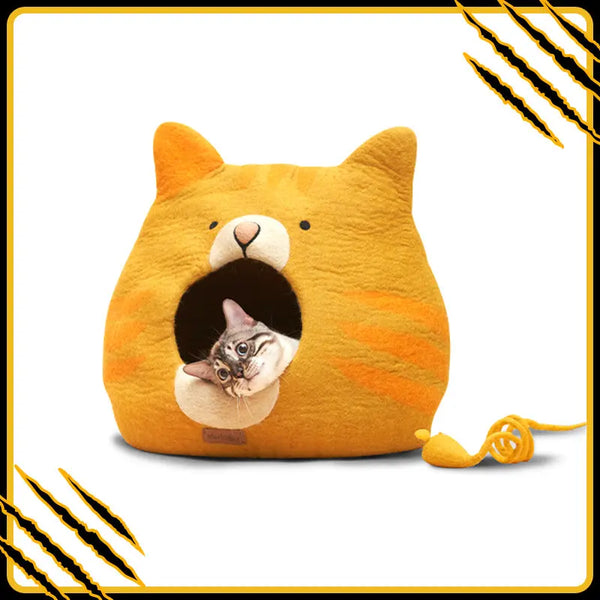
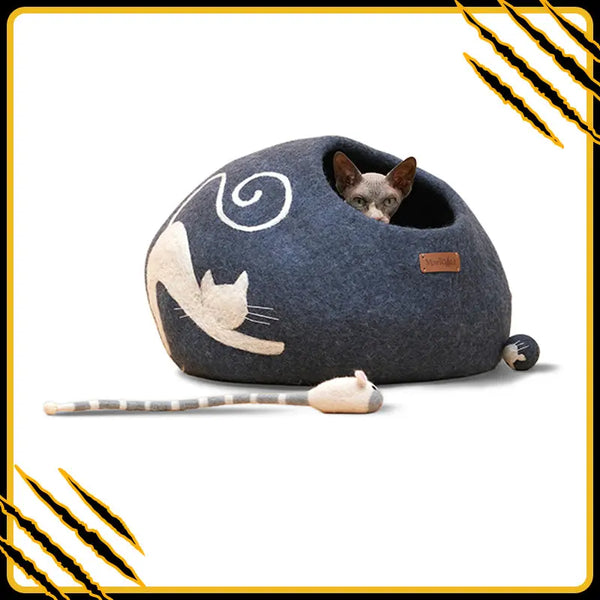
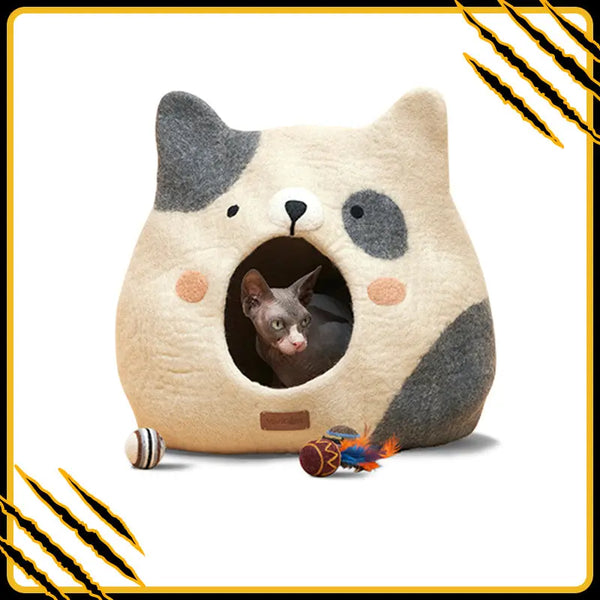
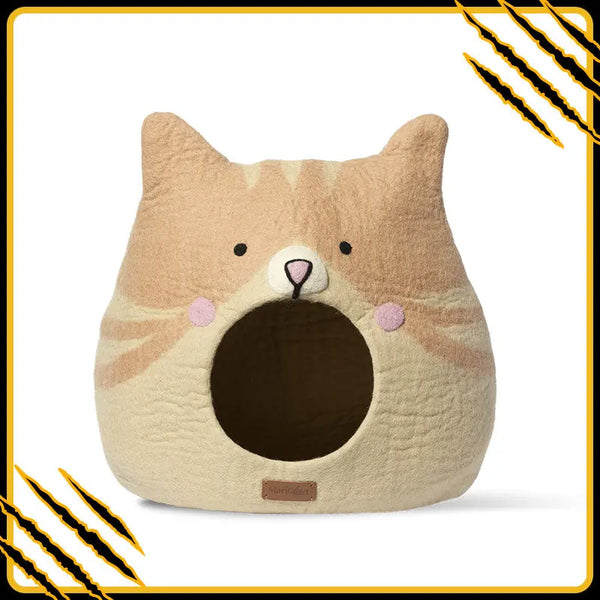
The wool cat cave represents the archetype of the perfect feline refuge. Its rounded shape with a single opening instinctively replicates the configuration of natural dens sought by wild felines: protection on all sides except one, allowing them to monitor the approach while knowing that no one can surprise them from behind.
The cocoon effect amplified : The felted wool adds a sensory dimension to this spatial security. The soft yet structured walls literally envelop the cat, creating the gentle pressure on its flanks that behaviorists call "calming compression." It's exactly the same principle as Thunder Shirts for anxious dogs or weighted blankets for humans.
Observational studies in animal shelters compared the behavior of cats with access to wool caves versus cats with other types of shelters. The result: cats with access to wool caves showed:
- 58% reduction in signs of stress (dilated pupils, flattened ears, tail swishing)
- 73% increase in time spent in deep sleep (versus light sleep while alert)
- 41% reduction in social avoidance behaviors
Optimal Dimensions and Proportions of a Wool Cave
Not all cat caves are created equal. Proper sizing is critical to maximizing the sense of security without causing discomfort:
For a standard-sized cat (3.5-5.5 kg) :
- Inner diameter: 35-40 cm
- Interior height: 28-32 cm
- Opening: 15-17 cm in diameter
- Wall thickness: minimum 1 cm of dense felted wool
For a large cat (6-9 kg, Maine Coon, Ragdoll, etc.) :
- Inner diameter: 45-50 cm
- Interior height: 35-38 cm
- Opening: 18-20 cm in diameter
- Wall thickness: 1.2-1.5 cm to maintain the structure
A common mistake : Buying a cat cave that's too big "so the cat is comfortable." An oversized cave loses its cozy feel and its ability to retain body heat. The cat should be able to turn around comfortably, but not have enough space for three different positions.
Closed vs. Semi-Open Cave: Which to Choose?
Completely enclosed cave with a small opening :
- Ideal for : Anxious, shy cats, or cats living in noisy/crowded environments
- Advantages : Maximum perceived security, optimal thermal and acoustic insulation, darkness conducive to deep sleep
- Drawback : Some claustrophobic cats may initially reject it
Semi-open cave (wider opening, sometimes two openings) :
- Ideal for : Curious, sociable cats who love to observe while resting, kittens in training
- Advantages : Better ventilation in summer, allows the cat to monitor its surroundings, easier entry/exit
- Disadvantage : Slight reduction in thermal and acoustic insulation
Selection tip : Observe where your cat naturally sleeps. If it consistently chooses very confined spaces (closed cupboard, narrow box), opt for an enclosed cave. If it prefers areas where it can see what's going on (open shelf, basket on a piece of furniture), choose a semi-open cave.
Colorful Wool Caves: Psychological Impact on Cats
Cats see colors differently than humans. Their vision is optimized for detecting movement, but they perceive the red-orange spectrum less well and favor blues, greens, and yellows. However, the color of the cat cave affects the feline less than the ambient lighting inside.
Dark colors (anthracite grey, black, dark brown) :
- Darker interior = deeper sleep
- Ideal for diurnal cats who have trouble resting during the day
- Superior thermal absorption (2-3°C warmer in winter)
Light colors (beige, cream, light grey) :
- Brighter interior = cat can monitor the outside
- Best for anxious cats who hate total darkness
- Thermal reflection in summer (remains cooler in high heat)
Bright colors (orange, turquoise, pink) :
- The impact is primarily aesthetic for the owners.
- The cat perceives these shades differently but has no documented preference.
- Allows you to seamlessly integrate the shelter into your decor
Wool Cat House: A Structured Alternative to a Cave
Structural Differences Between Cave and House
While a cat cave is generally round and enveloping, a wool cat house adopts a more structured architecture with angles, a distinct roof, and sometimes several "rooms." This configuration offers specific advantages:
Multi-level architecture : Some high-end cat houses incorporate a main living area on the ground floor and an observation platform on the roof. This configuration addresses two distinct feline needs: a secure refuge for rest and an elevated observation post for territorial surveillance.
Superior dimensional stability : The square or rectangular shape with reinforced corners maintains a rigid structure even without internal reinforcement. This allows for more spacious areas without the risk of sagging, ideal for multi-cat households or very large felines.
Modularity and adaptability : Several manufacturers offer modular wool cat houses where you can add extensions, connecting tunnels, or extra floors. This flexibility allows you to adapt the feline habitat to the changing needs of your cat family.
Woolen Houses for Multiple Cats: Optimal Configuration
Managing multiple cats in the same space requires careful architectural planning to avoid territorial conflicts. A multi-space wool cat house elegantly addresses this challenge:
Configuration for 2 cats that get along well :
- Two-bedroom house separated by a partition wall with passageway
- Dimensions: 70x40x35 cm minimum
- Two separate entrances (one per room) to avoid territorial blockages
- Central partition thickness: 0.8-1 cm for sound insulation between zones
Setup for 3+ cats in a harmonious colony :
- L-shaped or U-shaped structure with 3 separate chambers
- Central common area (optional) for social interaction
- Each room has its own entrance/exit
- Vertical hierarchy: zones at different heights to respect the social hierarchy
Golden rule : Never force two cats to share the same shelter space, even if they are friends. Each feline must have its own inviolable private territory where it can retreat without fear of intrusion.
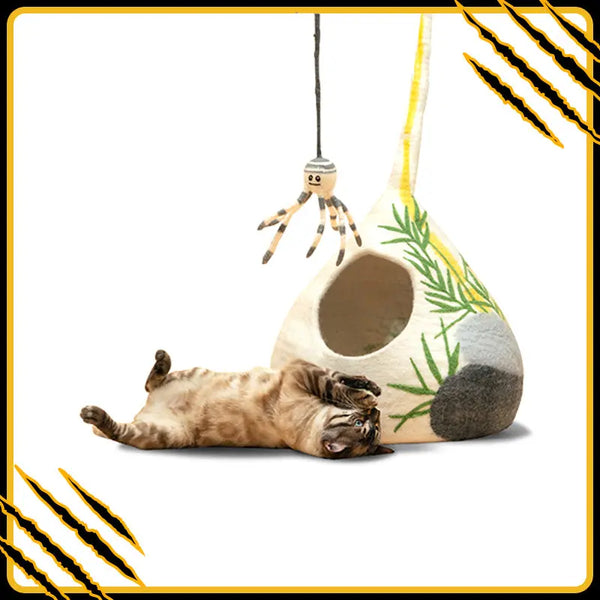
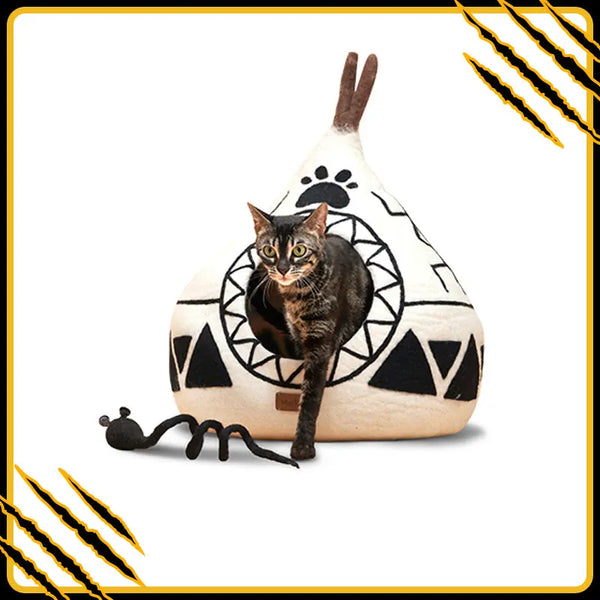
Wool Cat Teepee: The Compromise Between Openness and Protection
Why the Teepee Appeals to Some Cats Who Are Reluctant to Go into Caves
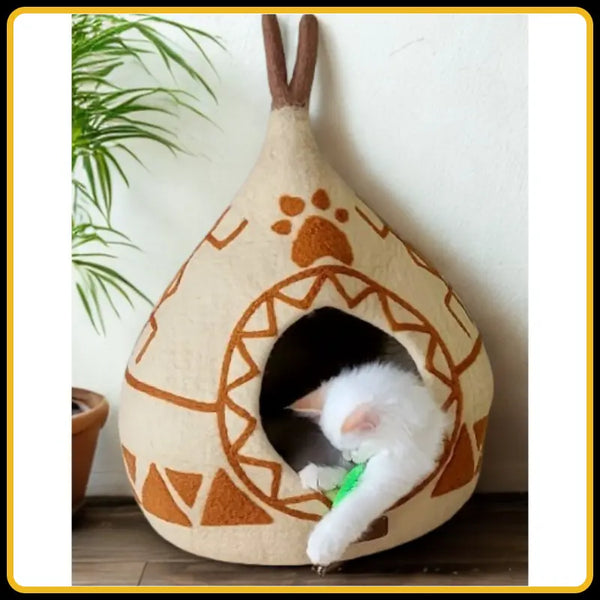
The cat teepee is a brilliant middle ground for felines who crave a refuge but dislike enclosed spaces. Its conical shape with a wide opening offers partial protection while maintaining a visual connection with their surroundings.
Psychological advantages of the tipi :
- Allows the cat to monitor its territory while being partially hidden.
- Reduces confinement anxiety in cats who have lived outdoors or in shelters
- Facilitates social interaction: the cat can see humans approaching and choose whether it wants attention.
- Ideal for the transition: a cat accustomed to open spaces that gradually learns to appreciate enclosed shelters.
Typical profile of a cat that prefers a teepee :
- A sociable cat who likes to be "at the center of the action" while still having his own personal space.
- Former stray cat accustomed to semi-covered spaces (under cars, bushes)
- Curious cat who hates missing out on house events
- Cats of very social breeds (Siamese, Burmese, Abyssinian)
Structure and Stability of the Wool Tipi
A well-designed cat teepee uses triangular geometry for its inherent stability, but usually requires an internal frame:
Traditional frame : 3-4 wooden rods (bamboo or beech) 50-70 cm long inserted into sleeves sewn into the wool. The rods meet at the top, creating a self-supporting structure. The advantage: it can be disassembled for easy washing.
Reinforced one-piece construction : Some artisans create teepees from extra-thick wool (1.5-2 cm) that is rigid enough to stand without a frame. The wool is worked in multiple cross-layers, creating a semi-rigid structure. The advantage: no metal or wooden parts that the cat could chew.
Weighted base : To prevent the teepee from tipping over when the cat enters or exits energetically, quality models incorporate a widened circular base (45-55 cm in diameter) sometimes with an integrated cushion that acts as a natural ballast.
Dimensions and Proportions of a Functional Tipi
For a standard cat :
- Total height: 45-50 cm
- Base diameter: 40-45 cm
- Opening: 18-22 cm wide
- Wool thickness: 1-1.5 cm
An important feature : Unlike a cave where the interior space needs to be adjusted, a teepee can be slightly more spacious because the wide opening compensates for heat loss. A cat will appreciate having a little extra room to stretch out while still benefiting from the protection of the conical roof.
Wool Cat Basket: Open Comfort and Versatility
When to Choose a Basket Rather Than a Cave?
A wool cat basket may seem less protective than a closed cave, yet it perfectly meets the needs of many felines, particularly those who prioritize thermal comfort over spatial security.
The basket is ideal for :
- Confident cats living in calm and predictable environments
- Senior cats with reduced mobility (easier entry/exit than in a cave)
- Very hot climates where a closed cave would be stifling.
- Additional use: the cat already has a cave for deep sleep, the basket is for naps while monitoring the cat.
- Cats that prefer to sleep stretched out rather than curled up
Typical profile of a cat who loves baskets :
- Dominant territorial cat who feels safe
- Long-haired breeds that overheat easily (Persian, Maine Coon)
- Sociable cat who likes to stay visible and accessible
- Seniors appreciate the ergonomic support without the effort of entering a confined space.
Ergonomic Design of Wool Baskets
A well-designed wool cat basket is not simply a wool bowl. It incorporates important orthopedic considerations:
Raised edges at optimal height : The edges should be 8-12 cm high, just enough to provide a headrest or back support when the cat sleeps on its side, but not too high to make it difficult for older or arthritic cats to access.
Slightly concave base : The bottom of the basket should form a gentle curve that naturally conforms to the cat's curled-up position. Optimal depth: 3-5 cm at the center. This shape distributes body weight evenly, avoiding pressure points that can be painful for cats with arthritis.
Removable integrated cushion : High-end wool baskets often include a removable carded (not felted) wool cushion that adds an extra layer of softness. Advantage: the cushion can be washed separately more frequently than the main structure.
Non-slip base : A good wool cat basket has a textured base or natural rubber micro-suction cups to prevent it from slipping on parquet or tile when the cat enters it suddenly.
Wool Baskets: Design Variations
classic round basket :
- Diameter: 38-45 cm
- Versatile and universal
- Fits easily anywhere
- Ideal for: cats sleeping curled up
Oval/elongated basket :
- Dimensions: 50-60 cm x 35-40 cm
- Perfect for cats sleeping stretched out
- Suitable for large cats
- Can accommodate two small, friendly cats
Basket with raised backrest :
- Back edge of 15-20 cm
- Provides secure back support
- Comfortable semi-reclining position
- Popular with cats who like to observe while resting
Nest basket (very high sides) :
- Rims of 18-22 cm forming almost an open cave
- Interesting compromise between a basket and a cave
- Significant side protection with preserved visibility
- Excellent for cats who are indecisive between open and closed
Wool Cat Shelter vs. Other Materials: A Complete Comparison
Facing Plastic: Health and Comfort
Plastic (polypropylene, PVC) : ❌ No thermal regulation: scorching hot in summer, freezing cold in winter ❌ Builds up unpleasant static electricity for whiskers ❌ Retains odors and promotes bacterial growth ❌ Uncomfortable rigidity for feline joints ❌ Potential release of chemical compounds (phthalates, BPA) ✅ Easy to clean with a hose ✅ Very economical (€15-40) ✅ Durable outdoors against the elements
Natural wool : ✅ Active thermoregulation: comfortable all year round ✅ Soft and antistatic surface ✅ Naturally antibacterial, minimizes odors ✅ Ergonomic flexibility that conforms to the body ✅ Zero toxicity even if ingested ❌ More delicate cleaning (hand wash in cold water) ❌ Higher price (€80-200 depending on size and finish) ❌ Requires protection outdoors in heavy rain
Verdict : For an indoor cat where comfort and health are paramount, wool is far superior to plastic. For a purely outdoor shelter exposed to extreme weather, plastic remains more practical, although a wool shelter under an awning is preferable.
Compared to Synthetic Fabrics: Durability and Hygiene
Polyester, nylon, microfiber : ❌ Moisture retention promoting mold and bacteria growth ❌ Rapid loss of shape (sags after 6-18 months) ❌ Development of unpleasant odors requiring frequent washing ❌ Accumulation of static electricity ✅ Machine washable at high temperatures ✅ Quick drying ✅ Very affordable price (€20-€60) ✅ Wide variety of designs and colors
Natural wool : ✅ Active moisture management without feeling damp ✅ Retains its shape for 10-15 years ✅ Remains naturally fresh for months ✅ Antistatic properties ❌ Gentle washing required (cold water, dry flat) ❌ Slow drying (24-48 hours depending on thickness) ❌ Higher initial investment (€80-200) ❌ Color palette limited by natural dyes
Verdict : If you need to wash the cat shelter frequently (sick cats, incontinent cats, or multiple cats with soiled beds), machine-washable synthetic materials might seem convenient. However, wool, requiring less washing thanks to its antibacterial properties, more than makes up for it with its superior durability and positive impact on health.
Facing the Woods: Aesthetics and Practicality
Wood (pine, cedar, plywood) : ✅ Natural aesthetic that blends into contemporary interiors ✅ Very robust and stable ✅ Excellent thermal insulation (solid wood) ✅ Exceptional longevity (15-25 years) ❌ Heavy and difficult to move ❌ Hard, uncomfortable surface without additional cushioning ❌ Requires regular treatment (oil, stain) ❌ Odor buildup in raw wood
Natural wool : ✅ Unparalleled softness and tactile comfort ✅ Lightweight for easy handling (cleaning, rearranging) ✅ Zero surface maintenance (no re-treatment required) ✅ Natural odor absorption rather than accumulation ❌ Less dimensionally stable (may deform slightly over time) ❌ "Textile" aesthetic less suited to some minimalist interiors ❌ Price comparable to quality wood (€120-200)
Verdict : Wood excels for large, permanent outdoor structures requiring maximum robustness. Wool surpasses it for indoor shelters where tactile and thermal comfort are paramount. Optimal solution: a wooden frame with a wool cushion/filling that combines the advantages of both materials.
Maintaining a Wool Cat Shelter: A Complete Guide
Daily and Weekly Cleaning
Wool requires less maintenance than commonly believed, thanks to its natural self-cleaning properties. However, regular, light care significantly extends its lifespan.
Daily routine (2 minutes) :
- Gently shake the cat cave or basket to remove loose hair and surface dust.
- Use a lint roller on the areas where the cat most often rests its head.
- Ventilate the inside by turning or repositioning the shelter.
Weekly routine (10 minutes) :
- Vacuum the entire external surface on a low power setting (or with a soft brush attachment).
- Gently brush the inside with a natural bristle brush to revive the fibers
- Expose the wool cat shelter to fresh air (open window, balcony) for 2-3 hours to evaporate accumulated moisture.
- Check for any damp areas or unusual odors that might indicate a problem.
Monthly or Quarterly Deep Cleaning
When to deep clean?
- Every 1-2 months for multi-cat households
- Every 3-4 months for a single clean cat
- Immediately in case of an accident (urine, vomit, diarrhea)
- Before the change of season (spring/autumn)
Hand washing method (recommended) :
- Preparation : Remove any removable cushions. Vacuum to remove hair and debris.
- Soaking : Fill a basin or bathtub with cold water (max 20°C). Add a special wool detergent or a mild, unscented shampoo (2-3 tablespoons per 10L of water). Completely submerge the wool cat house and let it soak for 15-30 minutes.
- Gentle cleaning : Gently press the submerged wool without rubbing or twisting. For localized stains, dab with a soft sponge dampened with soapy solution. NEVER USE aggressive circular motions, as these will cause further felting or distort the structure.
- Multiple rinses : Empty the soapy water. Refill with clean, cold water. Gently squeeze to remove the soap. Repeat 3-4 times until the water runs clear.
- Water extraction : Squeeze firmly but without twisting to remove excess water. You can roll the shelter in a large terry towel and squeeze to absorb more moisture.
- Drying : Lay flat on a well-ventilated horizontal surface (table with a rack, horizontal clothes drying rack). Gently reshape the garment into its original form with your hands. Turn over every 6-8 hours for even drying. Total time: 24-72 hours depending on thickness and weather conditions.
⚠️ NEVER DO THIS :
- Machine washing (even on a delicate cycle): will irreparably deform the structure
- Using hot water: shrinks wool by 20-30%
- Twisting or wringing: breaks the fibers and destroys the shape
- Tumble drying: guaranteed catastrophic shrinkage
- Hang to dry: gravity will irreversibly deform the structure
Alternative: Professional dry cleaning : For high-end or very large wool cat shelters, professional dry cleaning (specialized dry cleaners for delicate fabrics) guarantees optimal results without risk of deformation. Cost: €15-30 depending on size. Recommended frequency: 1-2 times per year.
Treatment of Stains and Accidents
Fresh urine :
- Absorb immediately with absorbent paper or a towel by pressing (do not rub).
- Dab the area with a 50/50 mixture of white vinegar and cold water
- Leave on for 10 minutes
- Rinse by patting with clean, cold water
- Sprinkle generously with baking soda
- Leave on for 8-12 hours to neutralize odors.
- Vacuum up the baking soda
- Ventilate completely (24-48 hours)
Vomiting or diarrhea :
- Carefully remove any solid matter with paper or a spatula.
- Local wash with cold water and mild soap, pat dry only
- Rinse thoroughly
- To deodorize: mix water + a few drops of lavender essential oil (antibacterial properties and acceptable for cats in very low concentrations)
- Complete drying is mandatory before reuse.
Prevention tip : For older, sick cats, or those with a history of accidents, place a washable, waterproof pad under the wool cat cave cushion. This protects the main structure while remaining comfortable for your feline friend.
Natural Deodorization Between Washes
Wool naturally has little odor, but in some cases (multiple cats, humid environment), deodorizing may be useful:
Baking soda (express method) :
- Sprinkle generously the inside of the wool cat basket
- Leave on for 2-4 hours (or overnight)
- Vacuum thoroughly
- Effect: Absorbs odors and residual moisture
Exposure to sunlight and fresh air :
- Place the wool shelter outside (or in front of a wide-open window) in good weather.
- The combined action of UV light and oxygen naturally destroys odor molecules and eliminates bacteria.
- Duration: 3-6 hours
- Frequency: once a month (optimal)
Homemade natural air freshener spray :
- 250ml of distilled water
- 2 tablespoons of white vinegar
- 3 drops of lavender essential oil (optional, a very small amount is acceptable for cats)
- Spray lightly from a distance of 30cm
- Allow to dry completely before reuse
Minor Damage Repair
Snag or small hole : Felted wool can be repaired by adding fibers and re-felting the area. Procedure:
- Prepare a small amount of carded wool of a similar color.
- Moisten the damaged area with warm soapy water
- Place the wool fibers over the hole
- Using a felting needle (available at haberdasheries), make hundreds of vertical stitches to integrate the new fibers with the old ones.
- Continue until the repair is solid and invisible
Slight deformation :
- Moisten the deformed area evenly.
- Manually reshape the desired structure
- Secure in place with tape or pins.
- Allow to dry completely (24-48 hours)
- The wool should retain the new shape
Gradual sagging : Over the years, a cat cave may sag slightly. Solution: Temporarily place crumpled newspaper or rolled-up towels inside to tighten the walls. Leave in place for 48-72 hours. Remove; the structure should have regained its firmness.
Choosing a Natural Wool Cat Shelter: Essential Buying Criteria
Wool Quality: How to Differentiate Between Handmade and Industrial Wool
Not all wool cat shelters are created equal. Quality varies considerably depending on the country of origin, the techniques used, and the raw materials used:
Handmade Nepalese or New Zealand wool (superior quality) :
- Traditional hand felting, taking 8-12 hours per piece
- Uniform thickness of 1-2cm throughout
- High density: 450-600g/m²
- Complete absence of glues or chemical binders
- Long fibers (8-15cm) for maximum strength
- Price: €120-250 depending on size and complexity
Semi-industrial wool (medium quality) :
- Machine-made felting with hand-finished details
- Variable thickness: 0.5-1.5cm depending on the area
- Average density: 300-400g/m²
- Sometimes reinforced with a thin layer of textile glue
- Medium fibers (4-8cm)
- Price: €60-120
Low-quality industrial wool (to be avoided) :
- Rapid, fully mechanized felting
- Thin and irregular thickness: 0.3-0.8cm
- Low density: 200-300g/m²
- Often glued onto a cardboard or foam frame
- Short fibers (2-4cm) = rapid loss of shape
- Price: €30-60 but lifespan limited to 1-2 years
Simple quality test upon purchase :
- Compression test : Firmly press the wall between your thumb and forefinger. Quality wool will instantly return to its original shape. Poor quality wool will remain compressed.
- Density test : Lift the shelter. It should be surprisingly heavy for its size (a 40cm cave should weigh 800-1200g).
- Visual test : Look closely at the surface. The fibers should be densely interwoven without sparse areas where you could see "through".
- Scent test : Quality wool has a neutral or slightly woolly natural odor. A chemical odor indicates the use of treatments or glues.
Certifications and Labels to Look For
Certified organic wool (GOTS - Global Organic Textile Standard) :
- Guarantees that the sheep were raised according to organic standards (without pesticides, extensive grazing)
- No post-production chemical treatment
- Dyes made exclusively from non-toxic plant-based or mineral sources
- Price premium: +20-30% but minimal environmental impact
Fair Trade (WFTO) :
- Ensures fair compensation for artisans
- Decent working conditions
- Preservation of traditional know-how
- Particularly important for Nepalese or Peruvian products
Oeko-Tex Standard 100 :
- Certifies the absence of harmful substances (heavy metals, formaldehyde, residual pesticides)
- Crucial for products in direct contact with animals
- Tests over 300 potentially dangerous substances
Made in Europe :
- Strict manufacturing standards
- Complete traceability of the production chain
- Often a sign of better durability than low-end Asian productions (note: high-end Nepalese craftsmanship is an exception)
Realistic Budget and Value for Money
Initial investment vs. cost over 10 years :
Scenario 1: Low-end purchase
- Synthetic basket: €30
- Shelf life: 18 months
- Replacement needed 6-7 times over 10 years
- Total cost: €180-210
- Comfort and health benefits: limited
Scenario 2: Average Quality
- Industrial wool cat house: €70
- Lifespan: 3-4 years
- Replacement needed 2-3 times over 10 years
- Total cost: €140-210
- Comfort and health benefits: satisfactory
Scenario 3: Superior quality (recommended)
- Handcrafted wool cat cave: €150
- Lifespan: 10-15 years
- No replacement needed
- Total cost: €150
- Comfort and health benefits: optimal
- Actual annual cost: €15/year
Budget conclusion : Purchasing a high-quality natural wool cat shelter represents the most cost-effective long-term investment, while offering the best benefits for feline health and well-being.
Sizes and Dimensions According to Breed
Small breed cats (2-4kg: Singapore, Munchkin, Cornish Rex) :
- Cave: diameter 30-35cm, height 25-28cm
- Basket: diameter 35-38cm
- Teepee: base 35cm, height 40cm
Standard-sized cats (4-6kg: European Shorthair, Siamese, Chartreux) :
- Cave: diameter 38-42cm, height 30-35cm
- Basket: diameter 40-45cm
- Teepee: base 40cm, height 45-50cm
Large breed cats (6-9kg: Maine Coon, Ragdoll, Norwegian Forest Cat) :
- Cave: diameter 45-50cm, height 35-40cm
- Basket: diameter 50-55cm (or oval 60x40cm)
- Teepee: base 50cm, height 55-60cm
Obese or overweight cats (9kg+) :
- Opt for open baskets rather than caves (easier access).
- Reinforced basket: 55-60cm in diameter
- Check the load capacity: minimum 12kg for a solid structure
Measurement tip : Measure your cat lying in a relaxed curled-up position (the circle formed by its body). Add 8-10cm to the diameter to get the ideal cave size. For a basket, add 12-15cm for extra comfort.
Environmental Impact: Why Natural Wool is the Ecological Choice
Comparative Carbon Footprint of Materials
Natural wool production :
- A resource that is renewed annually (spring mowing)
- Low-energy, artisanal processing (human labor vs. industrial machines)
- Transport: varies depending on origin (Nepalese = significant, European = limited)
- Estimated carbon footprint: 5-8 kg CO2 per kg of felted wool
Polyester production :
- Derived from petroleum (a non-renewable resource)
- Highly energy-intensive industrial process
- Refinery, polymerization, spinning: polluting stages
- Estimated carbon footprint: 15-20 kg CO2 per kg of polyester
Plastic production (rigid niche) :
- Also derived from petroleum
- High-temperature injection molding
- Estimated carbon footprint: 12-18 kg CO2 per kg of plastic
Environmental verdict : A cat shelter made of natural wool generates 50-70% less carbon emissions than a comparable synthetic equivalent.
Biodegradability and End of Life
Natural wool :
- 100% biodegradable
- Compostable (complete decomposition in 6-12 months in active compost)
- As it decomposes, it enriches the soil with nitrogen and other nutrients.
- Can be recycled: used felted wool can be defibrated and re-felted into new objects
- Zero pollution at the end of life
Synthetic materials :
- Non-biodegradable (persistence of 20 to 200 years depending on type)
- Release of microplastics during partial decomposition
- Complex and energy-intensive recycling, rarely carried out for small accessories
- Incineration = release of toxins into the atmosphere
- Landfilling = lasting pollution of soils and groundwater
Impact on wildlife : Synthetic textiles that degrade in nature release microfibers that are ingested by wildlife, causing intestinal blockages and poisoning. Wool decomposes naturally without toxicity.
Animal Welfare in the Production Chain
Ethical wool :
- Painless shearing (equivalent to a haircut)
- Essential for the well-being of sheep (prevents summer overheating and parasites)
- Animal welfare certifications available (Responsible Wool Standard)
- Supports extensive pastoral farming that preserves grassland ecosystems
Important note: Mulesing : This controversial practice (removal of skin to prevent parasite infestations) is banned in Europe but practiced in Australia. Choose wool certified "non-mulesing" or of European/New Zealand origin, where the practice is prohibited.
Synthetics :
- No direct animal welfare issues
- But oil pollution indirectly affects all ecosystems and wildlife.
Circular Economy and Local Craftsmanship
Buying a handcrafted wool cat house, especially if locally made or fair trade, supports:
- Preserving ancestral know-how threatened by industrialization
- Rural economies in disadvantaged regions (Nepalese mountains, Andean highlands)
- Human-scale production models vs. industrial relocation
- Preservation of locally adapted sheep breeds
Testimonials and Experiences: Cats Love Wool
Case Study 1: Minou, an Anxious European Shorthair Cat
Initial situation : Minou, a 5-year-old neutered male, lived in a 45m² apartment. Problematic behaviors: systematically hid under the bed as soon as a visitor arrived, always slept stretched out in the "bread" position, exhibited over-grooming on his belly (area of alopecia 4cm in diameter).
Existing equipment : A synthetic fabric basket in the living room (never used), access to the bed and cupboards.
Intervention : Installation of an anthracite wool cat cave (40cm in diameter) in the bedroom, in a quiet corner near the window but shielded from direct view. Positioned 1.2m high on a secure shelf.
Results after 6 weeks :
- Immediate adoption of the cave (first use on the same day)
- Gradual increase from 4-5 hours per day to 12-14 hours per day in the cave
- 80% reduction in excessive grooming behavior
- First observed sleeping on its side (relaxed position) after 3 weeks
- During visits, he now stays in his cave instead of hiding under the bed (major progress: he feels protected without having to flee)
Owner's quote : "It's as if Minou has finally found HIS space. He's no longer constantly stressed, you can tell he's calmer. The €135 investment has literally transformed his quality of life."
Case Study 2: Luna and Nala, Energetic Bengal Duo
Initial situation : Two Bengal females, 2 and 3 years old, in a 120m² house. Problem: Frequent territorial tensions, stressful chases, Luna (subordinate) showed signs of chronic stress (loss of appetite, avoidance).
Existing equipment : A single cat tree with an open platform, two plastic baskets on the floor (used sporadically).
Intervention : Purchase of two wool cat houses: a light grey closed cave for Luna (positioned high up in the quiet office), an open beige teepee for Nala (living room, overlooking the main room).
Results after 8 weeks :
- Each cat immediately adopted "her" house
- Drastic reduction in conflicts (clear territorial division respected)
- Luna has gained weight (+300g) and is now eating normally in her safe space.
- Observing simultaneous naps (Luna in her cave, Nala in her teepee) = a sign of social peace
- Games have become fun again rather than aggressive.
Owner quote : "I hadn't realized how much they needed clearly defined individual spaces. The wool houses created a naturally respected separation. They are finally both relaxed."
Case Study 3: Pixel, Senior Maine Coon with Arthritis
Initial situation : 12-year-old male Maine Coon, 8.5 kg, diagnosed with osteoarthritis in the hips and elbows. Increasing difficulty jumping, prefers to stay on the ground, often sleeps on the cold tiles (unusual behavior suggesting joint pain).
Existing equipment : Rigid plastic basket (uncomfortable for joints), access to the sofa (too high, no longer jumps).
Action taken : Purchase of a large oval wool cat basket (55x40cm) with a thick carded wool cushion. Placed on the floor in the living room, in a quiet area with a stable temperature.
Results after 4 weeks :
- Full adoption: Pixel spends 16-18 hours a day in his wool basket
- Stopped sleeping on the cold tiles (bad for arthritis)
- Owners report fewer nighttime vocalizations (an indicator of reduced pain)
- Sleeping position: often stretched out fully, a sign of muscle relaxation
- Veterinarian notes improved mobility during follow-up check-up
Owner's quote : "We can see the difference in his gait. Since he's had his wool basket, he gets up less stiffly in the morning. The natural warmth of the wool and the ergonomic support visibly relieve his painful joints. For a senior cat, it's a major health investment."
Wool Cat Shelter: Frequently Asked Questions (FAQ)
Will my cat damage the wool by scratching it?
High-quality felted wool is remarkably resistant to scratching. Its dense, interwoven structure prevents claws from catching as they would on woven fabric. Cats naturally sharpen their claws on rough, vertical surfaces (cat trees, posts), not on the soft, horizontal surfaces of their resting areas. Among thousands of users, damage from scratching is extremely rare. If your cat has a tendency to be destructive, opt for extra-thick wool (1.5-2 cm) for even greater durability.
Can wool trigger allergies in my cat?
Feline allergies to natural wool are extremely rare. Cats are far more sensitive to dust mites, pollen, and mold than to natural fibers. On the contrary, wool naturally inhibits dust mite proliferation (unlike synthetic fabrics, which promote it). If your cat has a true lanolin allergy (less than 0.1% of cats), it will manifest as excessive licking and skin redness within 48 hours. In this extremely rare case, simply returning the product resolves the issue.
Can I use a wool shelter on a balcony or outdoors?
Yes, but with protection from direct rain. Wool is quite resistant to atmospheric humidity (dew, mist) but should not be exposed to heavy rain, which would saturate it. Solution: place the cat cave under an awning, in an open garden shed, or under protective balcony furniture. The wool will then excel at regulating external temperature variations. For purely outdoor use without protection, opt instead for an insulated wooden shelter with a removable wool cushion.
How to prevent wool from pilling over time?
High-quality felted wool hardly pills (unlike wool knits). The felting process creates a compact surface where the fibers cannot separate and form pills. If you notice a slight surface fuzz after several years, this is normal: gently use a lint remover or a fabric pumice stone. Excessive pilling generally indicates poor-quality wool (short fibers, insufficient felting).
Does colored wool bleed color and is it toxic to cats?
High-quality wool is dyed with dyes that are fixed throughout and won't bleed. A simple test: rub a damp white cloth on the wool. If it stays white, the dye is stable. Opt for natural dyes (plant-based, mineral-based) certified by Oeko-Tex to guarantee the absence of toxic heavy metals. Cheap azo dyes used in low-end industrial production can indeed be toxic if ingested. All the more reason to choose cat shelters made from certified wool.
My cat is completely ignoring his new wool cave, what should I do?
It's frustrating but common! Follow the gradual introduction protocol mentioned earlier. Patience is key: some cats need 3-6 weeks to accept a new shelter. Additional tips: 1) Place the shelter exactly where the cat usually sleeps (even if it's not the ideal spot). Once accepted, gradually move it. 2) Put some Temptations treats inside (irresistible to 98% of cats). 3) Spray a calming pheromone spray (Feliway) inside. 4) Play with a fishing rod toy near the entrance to create positive associations. 5) Be patient and never force the issue.
What is the actual lifespan of a handcrafted wool cat shelter?
With proper care (cleaning every 3-4 months, regular airing), a high-quality, handcrafted wool cat cave or house easily lasts 10-15 years. Some users report exceptional, well-maintained pieces lasting up to 20 years. Limiting factors include prolonged exposure to direct sunlight (fading and weakening of the fibers over 8-10 years), chronic excessive humidity (mold growth if insufficiently dried), or complete neglect of maintenance. Compare this to the 18-36 month lifespan of low-end synthetic cat beds: the return on investment is incomparable.
Conclusion: The Natural Wool Cat Shelter, an Investment in Feline Happiness
Choosing a natural wool cat shelter – whether it's a cozy cat cave, a structured cat house, a stylish cat teepee, or an ergonomic cat basket – is much more than just buying an accessory. It's an investment in your companion's deep physical and psychological well-being.
The exceptional properties of handcrafted felted wool – active thermoregulation, intelligent moisture management, natural antibacterial properties, sound insulation, and soothing tactile comfort – create an optimal environment that synthetic materials simply cannot match. Your cat instinctively senses this, explaining the rapid adoption and intensive use observed in the majority of felines.
Beyond immediate comfort, you're also making a responsible, eco-friendly choice. Natural, biodegradable wool, renewable annually and produced using traditional, low-energy artisanal methods, stands in stark contrast to the polluting petroleum derivatives that dominate the pet accessories market. A wool cat bed that lasts 15 years has a far smaller environmental impact than 8-10 synthetic beds that are replaced one after another.
Admittedly, the initial investment in a handcrafted wool cat cave or cat house may seem high (€120-€200). However, considering its exceptional lifespan, the actual annual cost (€10-€15/year) makes it the most economical long-term option. Not to mention the invaluable health benefits: stress reduction, improved sleep, joint relief for senior cats, and prevention of respiratory problems related to humidity.
Your cat can't tell you in words how much its wool refuge transforms its daily life. But observe it: its extended hours of deep sleep, its happy kneading behavior on the woolly texture, its newfound serenity in a noisy environment. These silent signs speak for themselves.
By offering your feline companion a natural wool cat house, a handcrafted cat teepee, or an ergonomic cat basket, you're not just buying an accessory. You're creating a personal sanctuary where your cat can finally be its true self: relaxed, safe, and deeply happy.