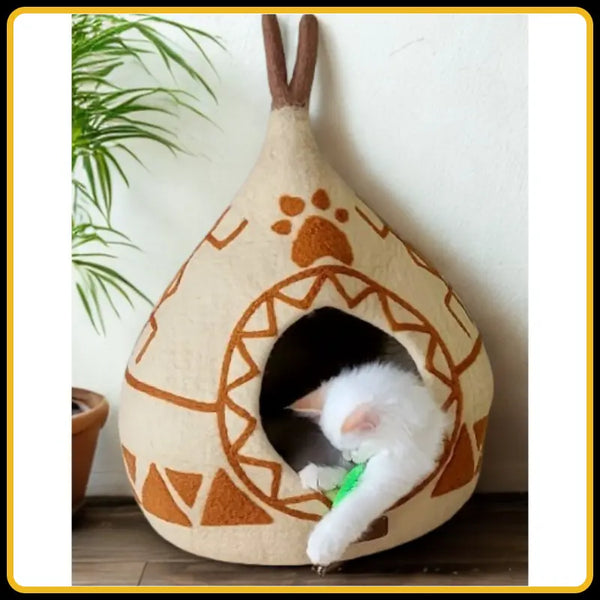
Cat Shelter: Understanding Your Feline's Territorial Needs and How to Meet Them
Cat shelter: A cat shelter isn't just a decorative piece of furniture; it's the key element that determines your feline's psychological well-being. Did you know that a cat spends an average of 70% of its life in refuge spaces and that the quality of these spaces directly influences its behavior, health, and even life expectancy? In this comprehensive educational guide, discover the scientific fundamentals of feline territorial behavior, learn to decode your cat's specific needs, and master the art of creating an optimal environment with the right, suitable shelters.
Cat Shelter: Why Understanding Cats' Territorial Behavior Changes Everything
The Wild Heritage: When Domestication Meets Instinct
Unlike dogs, which have been domesticated for over 30,000 years, cats have only lived with humans for about 10,000 years. This relatively recent domestication explains why our domestic felines retain 95% of the behaviors of their wild ancestors. The African wildcat ( Felis silvestris lybica ), the ancestor of all our domestic cats, is a solitary predator that establishes a hunting territory of 2-5 km² dotted with numerous strategic refuges.
What this means for your apartment : Your cat instinctively perceives your home as a territory to be organized into distinct zones. Without appropriate structures such as a cat cave , cat hide , or outdoor cat house , it will try to create its own shelters in often unsuitable places (under dusty beds, in cluttered closets, behind furniture).
The 5 Essential Territorial Zones of the Domestic Cat
Feline ethologists have identified five types of spaces that every cat instinctively seeks to establish in its environment:
1. The Deep Rest Zone (Absolute Priority)
This is the inviolable sanctuary where the cat achieves truly restorative sleep. This area must be:
- Dark or with controlled lighting (promotes melatonin production)
- Silent (sound insulation is crucial for urban cats)
- Thermally stable (minimal variations for physiological comfort)
- Inaccessible to other animals and children (safety guaranteed)
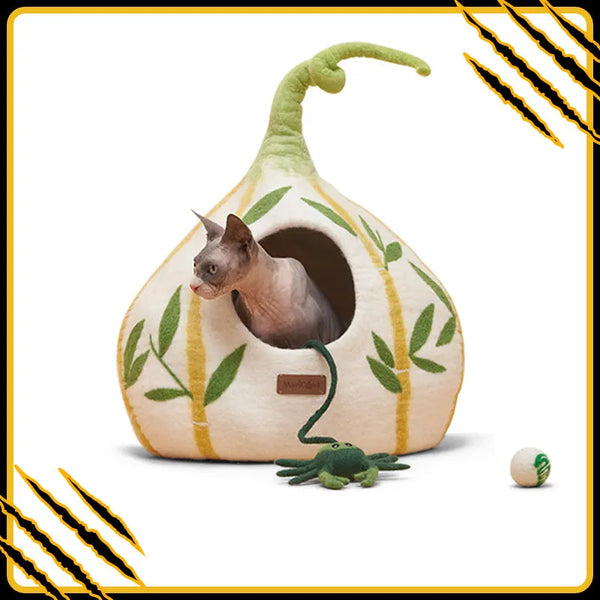
A well-positioned cat house or cat cave perfectly fulfills this function . Cats deprived of this area frequently develop sleep disorders manifesting as nighttime hyperactivity, irritability, and a weakened immune system.
2. The High Observation Zone
Cats are genetically programmed to survey their territory from elevated positions. Being high up makes a cat feel safe (it's harder to be surprised) and in control (it has a panoramic view). Lack of vertical access is one of the major causes of stress for cats living in apartments.
Optimal solution : Combine a raised cat hideaway (a secure shelf at 1.5-2m) with a cat tree offering multiple observation levels. For older or less mobile cats, install intermediate steps to facilitate access to higher levels.
3. The Simulated Game and Hunting Area
The hunting instinct is so deeply ingrained that it manifests even in overfed cats who have never hunted. Without a proper outlet, this need generates frustration and destructive behaviors (inappropriate scratching, ankle attacks, excessive meowing).
Recommended setup : A clear space of at least 3-4 square meters with rotating toys (change them every 3-4 days to maintain interest), tunnels, and hiding places for ambushes. Include a cat teepee or cardboard box in this area: your cat will love planning its "attacks" on the toys.
4. The Feeding Zone
Unlike dogs, which eat in packs, cats are solitary eaters who prefer discretion. A food bowl placed in the center of a high-traffic area stresses many felines, causing anorexia or anxious bulimia.
Golden rule : Separate the feeding area from the litter box area (at least 3 meters) and place it in a sheltered corner where the cat can eat with its back to the wall, watching for approaches. A cat basket or small hideaway can be positioned nearby (not too close to avoid negative association with food smells).
5. The Elimination Zone
The location of the litter box has a significant impact on feline cleanliness. A cat that doesn't feel safe while eliminating will quickly develop avoidance behaviors (urinating outside the box).
Optimal location criteria :
- Far from areas of heavy traffic
- Accessible from several directions (cats hate feeling trapped)
- Away from food and resting areas
- In a place where the cat can monitor approaches
Decoding the Signs: Your Cat Is Telling You It Lacks Safe Spaces
12 Revealing Behaviors of Inadequate Land Use Planning
Most owners misinterpret the territorial distress signals their cat sends them. Here's how to decode its behavioral language:
1. Sleeping in the Permanent "Bread" Position
Observation : Your cat always sleeps with its paws folded under its body, head raised, never on its side completely relaxed.
Meaning : Inability to reach deep sleep due to a lack of environmental security. This position allows for a quick departure in case of a perceived threat.
Solution : Install a cat cave in a quiet, secluded area. The enclosed space will trigger the complete muscle relaxation necessary for deep sleep.
2. Nighttime Hyperactivity (Crazy Cat Syndrome)
Observation : Frenzied running at 2am-4am, meowing, insistent requests to play.
Meaning : Accumulation of unused energy due to poor quality sleep during the day. The cat was unable to truly rest in a suitable shelter.
Solution : Provide a dark, soundproof cat bed to ensure quality daytime rest. Add intensive play sessions in the evening (20-30 minutes of simulated hunting) to tire the cat out physically before bedtime.
3. Systematic "Disappearance" When Guests Arrive
Observation : As soon as a stranger enters, the cat hides under the bed or in a cupboard and does not come out for hours.
Meaning : Lack of accessible and safe refuge in common areas. The cat must flee to uncomfortable and socially isolating hiding places.
Solution : Place a cat house or cat shelter in the living room in a spot where the cat can see without being immediately visible (behind a piece of furniture, in a corner). This "semi-hidden" position allows the curious cat to safely observe visitors without having to completely isolate itself.
4. Excessive Grooming Creating Areas of Alopecia
Observation : Compulsive licking of a specific area (belly, flank, hind legs) until a bald or irritated area is created.
Meaning : Self-soothing behavior in response to chronic environmental stress. Grooming temporarily releases endorphins but becomes pathological.
Solution : After a veterinary check-up has ruled out medical causes, enrich the environment with several strategically placed cat hideaways . Excessive grooming typically decreases by 60-80% when the cat has adequate safe spaces.
5. Redirected or Unpredictable Aggression
Observation : The cat attacks suddenly without apparent provocation: scratching during a caress, biting while playing, attacking ankles.
Meaning : The nervous system is in a state of constant overload due to the inability to "switch off" in a suitable refuge. The cat accumulates tension and frustration, which explode unpredictably.
Solution : Immediately create several refuge areas with strategically placed cat caves and cat beds . Redirected aggression decreases dramatically when the cat can voluntarily isolate itself to manage its excitement level.
6. Avoiding Certain Rooms or Areas
Observation : The cat never goes into the living room, or systematically avoids the kitchen, or refuses to enter a bedroom.
Meaning : This area is perceived as dangerous or uncomfortable. Possible causes: too noisy, no available refuge, disturbing odor, past traumatic event.
Solution : Make the area appealing by installing a comfortable cat shelter and providing positive reinforcement (treats, favorite toys). Gradual introduction over 2-3 weeks is usually enough to reclaim the avoided space.
7. Vertical Urine Marking (Outside the Litter Box)
Observation : Urine on walls, furniture legs, curtains (standing position, erect tail quivering).
Meaning : Territorial marking behavior indicating significant territorial insecurity. The cat is attempting to "reaffirm" its territory in the face of a perceived threat.
Solution : After sterilization (which reduces sexual marking by 90%), restructure the space with clearly defined cat sanctuaries designated as "feline property." Urine marking decreases when the cat feels it is the rightful owner of dedicated spaces.
8. Dietary Changes (Anorexia or Anxious Bulimia)
Observation : Sudden loss of appetite or, conversely, frantic gulping of food as if it were about to disappear.
Meaning : Territorial stress disrupts the hormones that regulate appetite (leptin, ghrelin). A cat that doesn't feel safe eats poorly.
Solution : Secure the feeding area with visual barriers (screen, furniture) and position a cat basket nearby (2-3 meters) to create a protected "food sanctuary".
9. Excessive Vocalizations (Frequent Plaintive Meows)
Observation : Repeated meowing for no apparent reason, particularly when the cat is alone or at night.
Meaning : A cry for help, anxious loneliness, or a search for compensatory attention in the face of an unsatisfactory environment.
Solution : Massively enrich the environment with cat houses , climbing areas, and interactive stimulation. A cat that is occupied and content with its territory vocalizes 70% less.
10. Prolonged Immobility in One Place
Observation : The cat stays for hours in the same place (often high up), staring without moving.
Meaning : Either anxious hypervigilance (permanent territorial surveillance), or feline depression (social withdrawal).
Solution : Differentiate by observing the ears: forward-facing = alertness (stress), flattened or unresponsive = depression. In both cases, secure cat shelters reduce the need for constant supervision and encourage exploration.
11. Destruction of Vegetation or Objects
Observation : Chewing of houseplants, destruction of papers, knocking over objects.
Meaning : Behavioral frustration, profound boredom, or an attempt to restructure the environment according to one's needs.
Solution : Channel destructive energy with appropriate toys AND create alternative areas of interest, such as a cat teepee filled with spinning toys. Adding cultivated catnip also provides an acceptable plant-based outlet.
12. Chronic Diarrhea or Vomiting Without Medical Cause
Observation : Recurrent digestive problems despite normal veterinary examinations.
Meaning : Chronic stress disrupts the feline digestive system via the gut-brain axis. Environmental anxiety manifests physically.
Solution : After medical exclusion, improving territorial layout with adequate cat shelters frequently reduces these symptoms by 50-70% in 4-8 weeks.
Types of Cat Shelters: Understanding Their Specific Functions
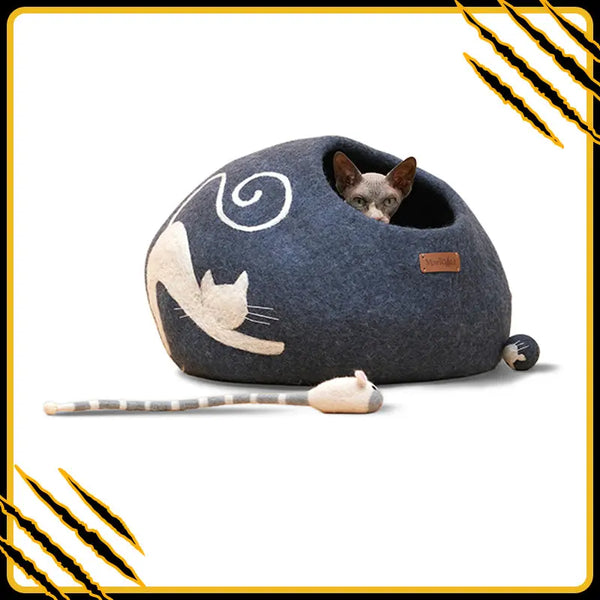
The Cat Cave: The Maximum Security Refuge
Primary behavioral function : Deep sleep and stress management zone
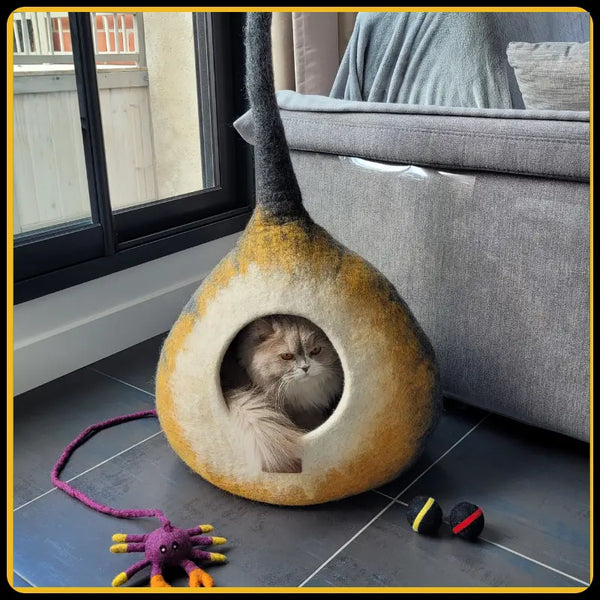
The cat cave fulfills the ancestral need for a den: a space enclosed on all but one side, offering relative darkness and thermal and acoustic insulation. This type of shelter triggers a deep relaxation neurological response in 90% of cats.
Profile of the cat that benefits the most :
- Anxious or shy felines
- Cats living in noisy environments (large families, city center)
- Animals that have lived in shelters or on the streets (require enhanced security)
- Multi-cats in a submissive position requiring an inviolable space
Optimal behavioral positioning :
- Quietest area of the accommodation (closed bedroom, office)
- Moderate height (60-120cm) for a feeling of security without difficulty of access
- Back to the wall with a view of the room's entrance
- Away from walkways and sources of noise (household appliances, television)
A common mistake : Placing the cat cave in the living room "so the cat can be with us." Result: The cave is ignored because it's too stimulating. The cat prefers a secluded refuge where it chooses to interact from a safe base.
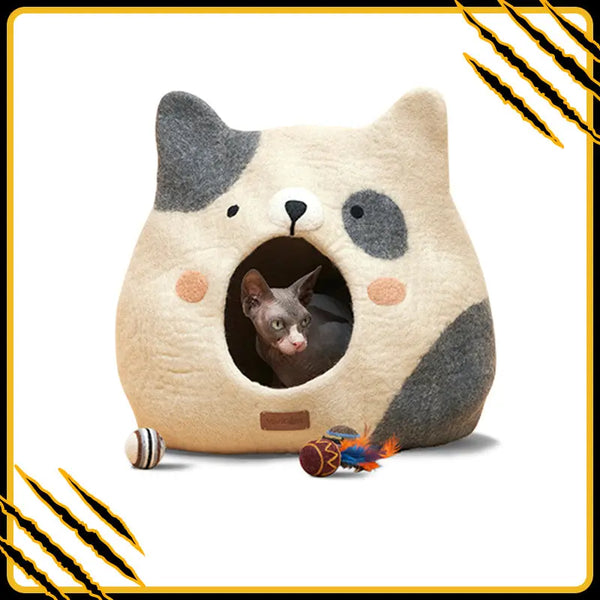
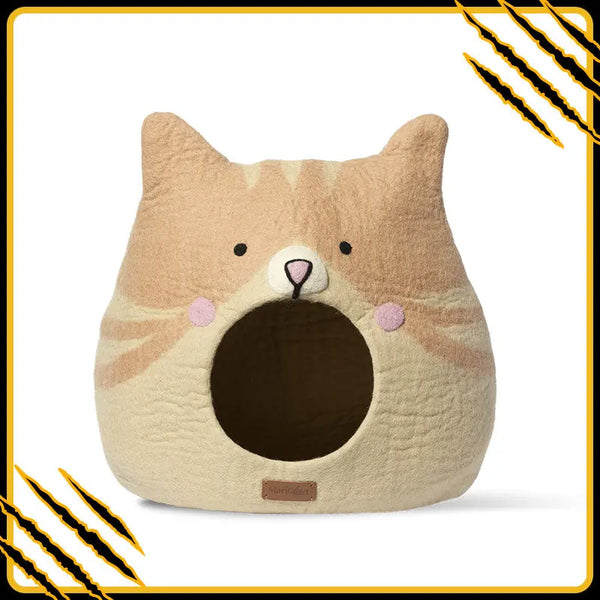
The Cat House: The Multipurpose Territory
Primary behavioral function : Multifunctional space (rest, play, observation)
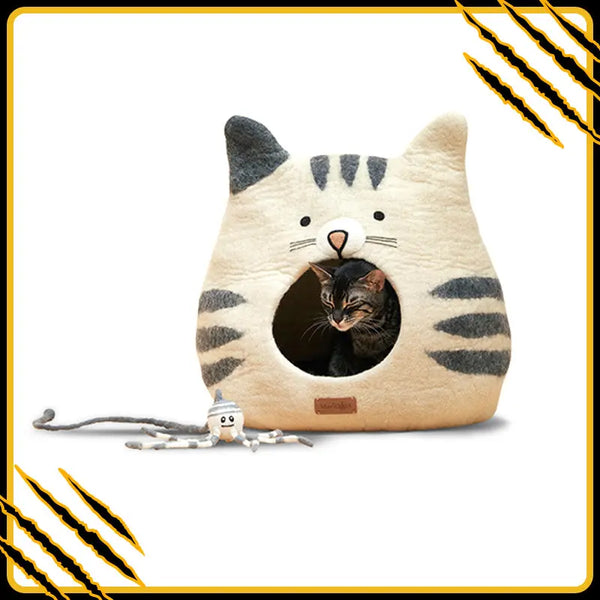
A cat house with structured architecture (a separate roof, sometimes windows or a balcony) offers more versatility than a simple cave. Some multi-level models combine a lower refuge with an upper observation post.
Profile of the cat that benefits the most :
- Confident and territorial felines who "own" their space
- Large cats requiring more space (Maine Coon, Ragdoll, Norwegian Forest Cat)
- Multi-cat homes where each animal has its own "primary residence"
- Cats that appreciate architectural complexity (intelligent breeds: Siamese, Abyssinian)
Optimal behavioral positioning :
- Intermediate zone between private and social space
- Allows the cat to be "present" without being exposed
- Ideally with visibility over several areas of the dwelling
- Perhaps the "central hub" from which the cat manages its territory
Educational benefit : To accustom a timid cat to social life, gradually move its cat house closer and closer to common areas (10-15cm per day). The mobile shelter supports its growing confidence.
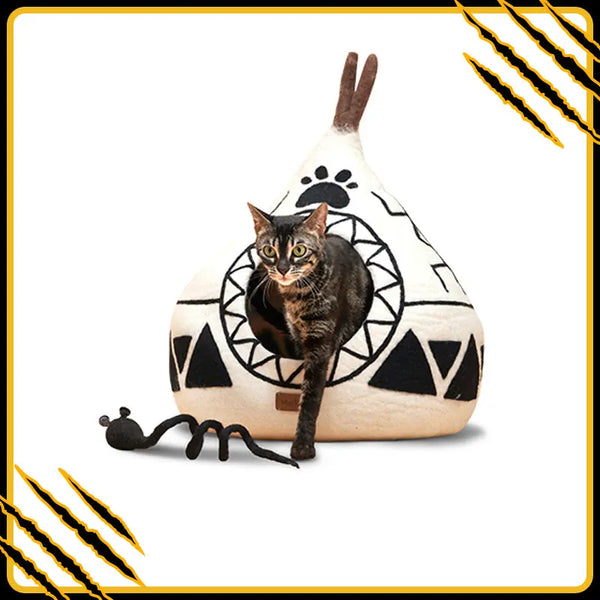
The Cat Teepee: The Security-Sociability Compromise
Primary behavioral function : Resting area with environmental monitoring
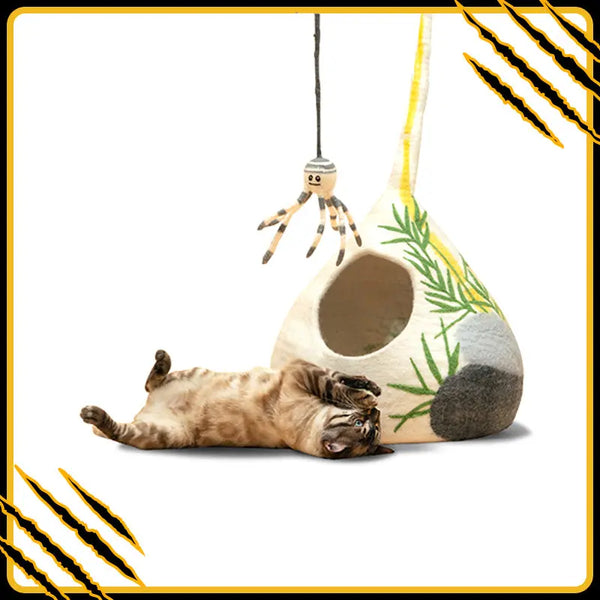
The cat teepee, with its wide opening, offers partial protection while maintaining visual contact with the environment. It's the refuge of the "social cat" who likes to stay connected.
Profile of the cat that benefits the most :
- Sociable felines who hate complete isolation
- Curious cats needing to "see everything" all the time
- Animals learning autonomy (transition from closed cave to open spaces)
- Highly social breeds (Oriental, Burmese, Sphynx)
Optimal behavioral positioning :
- Living room or main room with moderate activity
- Positioned to offer a panoramic view
- Close to, but not adjacent to, areas of human interaction
- Perfect for cats who want to "participate" in family activities without being physically involved.
Therapeutic use : Behaviorists use the teepee as a transition for agoraphobic cats, gradually helping them learn to tolerate exposure. Controlled visibility gradually desensitizes them to human presence.
The Cat Basket: The Thermal Comfort Zone
Primary behavioral function : Comfortable rest with thermoregulation
An open cat basket prioritizes physical comfort (ergonomics, warmth) over spatial security. It's the choice of cats who feel confident in predictable environments.
Profile of the cat that benefits the most :
- Dominant felines with secure territories
- Senior cats preferring easy access
- Long-haired breeds that avoid overheating (Persian, Ragdoll)
- Animals living alone in quiet homes
Optimal behavioral positioning :
- Areas with stable temperature (avoid proximity to radiators/air conditioning)
- Near a moderate natural heat source (sunny window in winter)
- Easily accessible for older or arthritic cats
- Can be positioned in a social space for very confident chat
Training tip : To encourage a cat to use common areas, start with a basket (less intimidating than a cave) in the desired area. Once the cat has adopted it, you can add more structured hiding places.
The Outdoor Cat House: The Bridge Between Two Worlds
Primary behavioral function : Safety during external territorial exploration
The outdoor cat kennel or outdoor cat house serves as an emergency shelter, strategic retreat point, and weather protection for felines with access to the outdoors.
Profile of the cat that benefits the most :
- Outdoor cats or cats with access to a balcony/terrace/garden
- Territorial felines patrolling regularly
- Animals living in extreme climate zones (heat waves or extreme cold)
- Neighborhood or semi-feral cats requiring protection
Optimal behavioral positioning :
- Dominant position with unobstructed views of the surrounding area (slight height)
- Protection against prevailing winds and inclement weather
- Halfway between areas of interest (house, territorial boundaries)
- Near, but not too near, community food points
Social dimension : For cat colonies, an outdoor cat house becomes a neutral "meeting point" where feline social interactions are naturally regulated. Always plan for several outings (minimum 2) to avoid territorial disputes.
Optimal Land Use Planning: Creating a Balanced Feline Environment
The 3-5-7 Rule for a Happy Cat
Feline behaviorists recommend the "3-5-7" rule for comprehensive territorial management:
3 Different Heights Available :
- Soil (0-30cm): baskets, tunnels
- Average height (80-120cm): shelves, low furniture
- Tall (150-200cm): cabinet tops, high shelves
This verticality multiplies the space perceived by the cat without increasing the floor area. A cat with three levels effectively uses its territory as if it were 2.5 times larger.
5 Types of Functional Zones :
- Deep resting area (cave/niche)
- Observation zone (height with view)
- Game/hunting area
- Food area
- Disposal area
Each zone must be clearly identifiable and physically separated (minimum 1.5m between incompatible functions such as food-litter).
7 Rotating Points of Interest :
- 2-3 different shelters ( cat shelters , baskets, caves)
- 2 observation posts
- 2-3 play stations with changing toys
Rotation maintains environmental interest. Change the setup every 10-15 days: move a cat basket , reposition a cat teepee , add a new tunnel. This controlled variability stimulates exploration without creating anxiety.
Configuration for Multi-Cat Households: Avoiding Territorial Conflicts
Golden Rule: N+1 for All Resources
For N cats, plan for N+1 of each essential resource:
- 3 cats = 4 cat shelters
- 3 cats = 4 litter boxes
- 3 cats = 4 water bowls
This over-allocation ensures that no individual can monopolize all the resources, drastically reducing tensions.
Vertical Spatial Hierarchy
Cats naturally establish social hierarchies. The dominant cat usually occupies the highest levels, while subordinates occupy the middle and lower levels. Respect this hierarchy:
- Dominant cat : elevated cat cave (shelf 180cm+), panoramic view of territory
- Intermediate cat : cat house for medium-sized cats (100-150cm), side areas
- Subordinate cat : cat house on the ground but in a protected corner, multiple escape routes
Fatal mistake : Forcing the subordinate cat to use the elevated refuge "because it's better." Result: intense stress, aggression from the dominant cat, and an unused refuge. Respect the established social hierarchy.
Buffer Zones and Spatial Separation
In multi-cat households experiencing conflict, create separate "cat apartments":
- Cat A: Room 1 with its shelter, water, food
- Chat B: Room 2 with full amenities
- Common area: lounge with additional neutral resources
Open up gradually between zones over 4-8 weeks, allowing gradual reintroduction under supervision.
Indoor Cats vs. Outdoor Cats: Different Needs
100% Indoor Cat: Compensating for the Lack of Exploration
Complete confinement requires maximum environmental enrichment:
- A minimum of 3 cat shelters of various types (cave + basket + teepee)
- Vertical complexity (cat trees, wall shelves)
- Weekly rotation of toys and setups
- Sensory stimulation: catnip, accessible windows (bird view), cat videos
Special note : Indoor cats are more prone to obesity, chronic boredom, and compulsive behaviors. A rich environment with stimulating cat caves and play areas partially offsets these risks.
Chat with External Access: Securing Transitions
Indoor-outdoor cats require:
- Comfortable indoor cat shelter for post-exploration rest
- Outdoor cat house or cat kennel in garden/balcony as an external security point
- Buffer zone (veranda, airlock) allowing for gradual transitions
- Resources duplicated indoors AND outdoors (cats hate "going inside" just to eat/use the litter box)
Safety aspect : An outdoor cat house also protects against predators (birds of prey, stray dogs) and extreme weather conditions. It can literally save the life of a cat caught in a storm or being chased.
Positive Training: Teaching Your Cat to Use Its Refuges
Gradual Introduction Protocol (PIP): 4 Weeks for a Successful Adoption
Week 1: Passive Familiarization
- Install the new cat shelter in a medium-traffic area.
- Do not close any openings; leave them fully accessible.
- Place in the immediate vicinity (30cm) but NOT inside: favorite toy, familiar blanket
- Don't interact; let the cat explore at its own pace.
- Objective : The cat passes near the shelter without anxiety and can sniff it without pressure.
Week 2: Olfactory Attractiveness
- Rub a soft cloth on the cat's cheeks (facial pheromone glands)
- Dab the inside of the shelter with this impregnated fabric.
- Place 2-3 tempting treats right at the entrance (not at the back!)
- Add an item of clothing you've worn (your scent is reassuring).
- Observe discreetly: if the cat enters spontaneously, do not react! Any attention could scare it away.
- Objective : The cat associates the shelter with familiar and positive smells.
Week 3: Positive Reinforcement
- Play with a fishing rod/feather duster near the shelter (50cm away)
- Verbally reward ("Yes!", "Good job!") any voluntary approach
- If the cat enters, immediately toss a premium treat inside.
- Short sessions (5-10 min) 2-3 times a day
- Gradually increase the proximity of the game to the shelter.
- Objective : The cat understands that approaching/entering generates positive consequences.
Week 4: Positional Optimization
- Once the shelter is adopted (cat spends at least 30 minutes a day there), you can optimize it.
- Move very gradually (10-15cm per day maximum) towards the final ideal position
- Add an extra cushion if desired
- Start spacing out food rewards (intermittent reinforcement is more effective in the long term)
- Objective : The shelter is perfectly positioned and used spontaneously without systematic reward.
Success rate : 85-90% complete patient adoption with this protocol versus only 40% with direct introduction without preparation.
Troubleshooting Adoption Problems
Problem 1: The cat completely ignores the shelter after 3 weeks
Possible causes :
- Shelter too big or too small (incorrect feel)
- Unsuitable location (too noisy, too busy, unpleasant smell)
- Off-putting texture (some cats hate certain fabrics)
- Preferred existing shelter already established (cardboard box, closet)
Solutions :
- Swap test: Temporarily exchange the new shelter with the current preferred shelter for 48 hours to allow familiar scents to develop.
- Repositioning: Place the shelter EXACTLY where the cat currently sleeps (even if it's not your aesthetic preference).
- Extreme attractiveness: Sprinkle with dried catnip, place Temptations treats (irresistible to 95% of cats)
- Prolonged patience: Some very wary cats require 6-8 weeks, especially former stray or shelter cats.
Problem 2: The cat enters briefly and then immediately leaves again
Possible causes :
- Persistent chemical odor (new plastics, glues, treatments)
- Uncomfortable interior space (too narrow, too sharp an angle, not enough litter/cushion)
- Poor ventilation creates a buildup of odors.
- Unsafe position (back exposed, no visibility of the room entrance)
Solutions :
- Intensive ventilation: Leave the shelter outside or windows open for at least 72 hours
- Added comfort: Plush cushion, soft fleece blanket
- Orientation test: Rotate the shelter 90° every 2 days until you find the optimal angle.
- Temperature check: Touch the inside - if it is much colder/warmer than the outside, the cat feels uncomfortable
Problem 3: One cat monopolizes the shelter, preventing others from accessing it (multi-cat household)
Causes :
- Insufficient number of shelters (must be N+1)
- Rigid social hierarchy with territorial dominance
- A unique shelter perceived as a "premium" resource to defend
Solutions :
- Immediate purchase of 2-3 additional cat shelters in different styles
- Strategic positioning in separate areas (not side by side)
- Make all shelters equally attractive (same quality of cushions, same level of comfort)
- Behavioral intervention: If the dominant cat growls/attacks when a subordinate approaches, consult a feline behaviorist.
Problem 4: The cat uses the shelter but develops undesirable behaviors inside (urine marking, destruction)
Causes :
- Negative association (stressful event during use)
- Territory violated (child/other animal forced entry)
- Generalized territorial anxiety manifesting in the shelter
Solutions :
- Complete enzymatic cleansing if urine staining is required
- Repositioning in a completely different area (a new psychological beginning)
- Strict family rule: The cat's sanctuary is SACRED, no human/animal intrusion tolerated.
- If destruction occurs: Check that the cat has enough alternatives for scratching and chewing (posts, dental toys).
Advanced Techniques: Modifying Rest Preferences
Objective : To gradually move the cat from an unsuitable shelter to a better one.
Common example: Cat that sleeps exclusively under the bed (dusty space, bad for breathing) and ignores all shelters offered.
6-step transition protocol :
Step 1 (Days 1-5) : Place the new cat shelter directly under the bed, next to the exact spot where the cat sleeps. Do not change anything else.
Step 2 (Days 6-10) : Make the old location slightly less comfortable: remove any cushions/soft fabrics the cat had arranged, leaving only the hard floor. The new shelter will become comparatively more attractive.
Step 3 (Days 11-15) : Enrich the shelter: add a heating pad (body temperature 38°C), treats, and favorite toys. Drastically increase its relative attractiveness.
Step 4 (Days 16-20) : Once the cat is regularly using the shelter under the bed, begin moving it. Progress very slowly: 10-15 cm per day towards the exit from under the bed.
Step 5 (Days 21-35) : Continue the gradual relocation until the shelter is completely removed from under the bed. Position it next to the bed, keeping all the attractive elements in place.
Step 6 (Days 36+) : Once the cat is fully adapted to the shelter out of under the bed, you can move it to its final optimal position (always in increments of 10-15 cm per day).
Key to success : Absolute patience. Rushing = guaranteed failure. This protocol takes 6-10 weeks but works in 80% of cases.
Impact on Physical Health: Shelters and Medical Well-being
Prevention of Pathologies Related to Chronic Stress
Environmental stress resulting from inadequate land-use planning is not just a behavioral problem. It generates documented medical pathologies:
Feline Idiopathic Cystitis (FIC) :
- Chronic bladder inflammation without a bacterial cause
- Triggered/aggravated by stress in 60-80% of cases
- Symptoms: painful urination, hematuria, urinating outside the litter box
- Essential complementary treatment : Stress reduction through environmental improvement (addition of cat shelters , territorial enrichment)
- Studies show a 40-60% reduction in relapses when the environment is optimized.
Psychogenic Dermatitis :
- Compulsive licking causing skin lesions, alopecia, secondary infections
- Psychological origin: anxiety, boredom, territorial frustration
- Treatment : Medication (if necessary) + environmental restructuring with cat caves to allow for self-management of stress
- Without environmental modification, relapse rate of 70-90%
Feline Obesity :
- Often linked to chronic boredom and lack of activity
- Cats without a stimulating environment eat out of boredom.
- Prevention : Complex layout encouraging physical activity, strategically placed shelters requiring movement, attractive play areas
- Adding 3-4 cat shelters at different levels forces the cat to climb/descend regularly, increasing calorie expenditure by 15-25%.
Immune Disorders :
- Chronic stress suppresses the immune system via high cortisol levels.
- Stressed cats develop more respiratory, digestive, and skin infections.
- Slowed wound healing, diminished vaccine response
- Impact of shelters : Cats with secure spaces show 30-50% lower salivary cortisol levels.
Therapeutic Shelters for Sick or Convalescent Cats
Post-operative: The Recovery Refuge
A cat recovering from surgery needs a suitable shelter:
- Easy accessibility : Low entrance or ramp for cats with restricted movement
- Easy monitoring : Open cat basket or cat house with a wide opening allows observation without handling.
- Maximum comfort : Orthopedic cushion, stable and warm temperature
- Isolation from other animals : Closed room with dedicated cat cave
Veterinary studies : Post-operative cats in secure environments with suitable shelters show:
- Healing 20-30% faster
- Painkiller needs reduced by 15-25%
- Infectious complications reduced by 35%
- Return to normal behavior 40% faster
Chronic Diseases: Adapting the Environment
Diabetic cat :
- Multiple shelters avoiding long and tiring journeys
- Cat basket near resources (water, food, litter)
- Stable temperature (variations cause stress and disrupt blood sugar levels)
Cat with kidney failure :
- Multiple water points accessible from the shelters
- Cat caves near food bowls (dehydration = extreme fatigue)
- Avoid excessive heights (possible dizziness)
Arthritic cat :
- Cat baskets on the floor only (no more elevated shelters)
- Memory foam orthopedic cushions
- Easy access: gentle ramps, intermediate steps
- Constant warmth (relieves joint pain): ideal natural wool cat shelters
Senior cat :
- Shelters accessible without jumping (maximum 30-40cm from the ground)
- Soft night lighting for impaired vision
- Bed linen nearby (partial incontinence is common in seniors)
- Cat bed with extra-wide entrance (for those with arthritis who have limited flexibility)
Landlord Education: Common Mistakes to Avoid
The 10 Major Mistakes in Land Use Planning
Mistake #1: One Refuge for Everything
Problem : Owners think that a cat cave is sufficient for all needs.
Fact : A cat needs different types of spaces depending on its activity and mood. A cave for deep sleep is not suitable for active observation or social rest.
Solution : Minimum 3 shelters of different types (cave + basket + high observation post).
Mistake #2: Ignoring Verticality
Problem : All shelters are at ground level.
Fact : Cats are natural climbers who feel safer at heights. A lack of vertical access generates frustration and stress.
Solution : Distribute cat shelters on a minimum of 3 levels (ground, medium height 80-120cm, high height 150-200cm).
Error #3: Positioning the Shelter in the Passage Zone
Problem : Cat house placed in the entrance, main hallway or in front of the door.
Fact : Cats hate being disturbed while resting. A hideaway in a high-traffic area will never be used for deep sleep.
Solution : Quiet, secluded areas with low human traffic. The cat must be able to sleep for 8 hours undisturbed.
Mistake #4: Forcing the Cat to Enter the Shelter
Problem : Frustrated owners physically push the cat into the shelter "to show it".
Reality : This forced intrusion creates an immediate and lasting negative association. The cat will permanently avoid this shelter.
Solution : Absolute patience, positive reinforcement only, respecting the cat's voluntary exploration pace.
Mistake #5: Neglecting Maintenance and Hygiene
Problem : Shelter never cleaned, accumulation of hair, odors, parasites.
Fact : A dirty shelter is repulsive to a cat, whose sense of smell is 14 times more developed than a human's. It will gradually abandon it.
Solution : Minimum bi-monthly cleaning, weekly ventilation, changing cushions every 2-3 months.
Mistake #6: Buying a Shelter That Is Not the Right Size for the Cat
Problem : Cat cave too small (cat cannot turn around) or too large (loses cocoon effect).
Reality : Incorrect sizing = discomfort = non-use.
Solution : Measure your cat when curled up, add 8-10cm to the diameter to obtain the optimal size. Consult breed-specific sizing guides.
Mistake #7: Placing Food or Litter Too Close to the Shelter
Problem : Bowls or litter box less than 1.5m from the resting shelter.
Reality : Cats instinctively separate elimination/feeding areas from resting areas (ancestral anti-parasitic hygiene).
Solution : Minimum 3 meters between shelter and food bowls, minimum 4 meters between shelter and litter box.
Mistake #8: Neglecting Individual Needs in a Multi-Cat Household
Problem : Only one cat shelter "to be shared" between several felines.
Reality : Generates competition, stress, conflict. The dominant figure monopolizes power, the subordinates are left without refuge.
Solution : Absolute rule N+1. 3 cats = minimum 4 shelters well distributed spatially.
Error #9: Constantly Changing Shelter Locations
Problem : Moving the cat house or cat kennel frequently "to try different locations".
Fact : Cats are territorial animals that mentally map their environment. Constant changes create disorientation and anxiety.
Solution : Once the shelter is adopted, maintain the location for a minimum of 3-6 months. If a change is necessary, proceed with small movements (10-15cm/day).
Mistake #10: Buying for Aesthetics Rather Than Functionality
Problem : Choosing a beautiful but unsuitable cat teepee or cat house (uncomfortable material, incorrect dimensions, color repulsive to the cat).
Reality : The cat doesn't care about your aesthetic preferences. Only comfort, safety, and appropriate size matter.
Solution : ALWAYS prioritize function over form. An "ugly" but perfectly functional shelter will be used; a beautiful but unsuitable shelter will become a useless decoration.
Special Cases: Unique Situations and Tailored Solutions
Kittens: Establishing Good Habits From the Start
0-3 months: Critical Socialization Phase
Kittens are discovering the world and establishing their environmental preferences for life. This is THE time to create positive associations with shelters.
Suitable shelters for kittens :
- Soft and warm cat bed (immature thermoregulation requires external heat)
- Extra-large inputs (limited motor coordination, frequent falls)
- Maximum height 40-50cm from the ground (fall protection)
- Several shelters for exploration (maximum curiosity at this age)
Positive impregnation technique :
- Place the mother (if present) in/near the shelter (kittens will follow).
- Game sessions always end near the refuge
- Meals initially given right at the entrance (food-shelter association)
- Cuddles and petting moments in the shelter
Result : Adult kitten with a strong preference for structured shelters, habit of voluntarily withdrawing to manage excessive stimulation.
Adopted Adult Cats: Rebuilding Security
Cats from shelters or rescues often arrive traumatized, wary, and hypervigilant. Establishing a safe haven is crucial for their well-being.
Specific protocol for the first month :
Week 1: Minimal Sanctuary
- A single, quiet room with a cat cave in the most secluded corner
- No forced interaction
- Essential resources (water, food, litter) accessible without leaving the room
- Humans only enter for service and resources (discreet, silent).
Weeks 2-3: Gradual Expansion
- Door ajar allowing voluntary exploration of other rooms
- Additional shelters installed in adjacent rooms
- Human interactions are initiated ONLY if the cat solicits them
Week 4+: Full Integration
- Free access to the entire accommodation
- A minimum of 3 strategically located cat shelters
- The original shelter remains an inviolable "secure base" where the cat can always take refuge.
A common mistake : Well-intentioned owners who "want to help" by forcing interactions, cuddles, and handling. Result: behavioral regression and increased mistrust.
Golden rule : Let the cat control EVERYTHING. Speed of adaptation, social interactions, territorial exploration. Your role: provide a safe environment with appropriate hiding places, then WAIT.
Senior Cats: Adapting the Environment to Declining Abilities
Sensory changes (decreased vision, hearing, sense of smell) :
- Enhanced visual cues : Mark shelter entrances with contrasting colored tape
- Soft night lighting : LED night lights for safe navigation without glare.
- Intensified familiar scents : Regularly impregnate cat shelters with fabrics carrying your scent + feline pheromones
Physical changes (osteoarthritis, muscle weakness) :
- Elimination of height restrictions : All shelters must be a maximum of 40-50cm from the ground
- Ramps and steps : Easy access to even the smallest inclines
- Wider entrances : Cat house with a 20-25cm opening (reduced joint flexibility)
- Orthopedic cushions : Memory foam or gel to relieve painful joints
Behavioral changes (increased anxiety, disorientation) :
- Strict routine : NEVER change the location of the senior cat's shelters
- Multiple shelters : Avoid long, tiring journeys; place a cat basket in each frequently used room.
- Constant warmth : Senior cats have difficulty regulating their body temperature; opt for cat caves made of natural wool or with heating pads.
Warning sign : A senior cat suddenly abandoning its usual shelter is often an indicator of pain or illness. Immediate veterinary consultation is recommended.
Introducing a New Animal: Territory Management
Arrival of a kitten in a home with an adult cat :
Phase 1 (Days 1-7): Total Separation
- Kitten in quarantine with its own cat shelter
- An adult cat keeps its usual territory unchanged
- Exchange of scents via fabrics (rub the cat, place it in the other cat's hiding place)
Phase 2 (Days 8-14): Eye contact without physical contact
- Ajar door with grille/barrier allowing mutual observation
- Meals given simultaneously to each side (positive association)
- Each person keeps their own separate refuges
Phase 3 (Days 15-21): Reverse Territorial Exploration
- Kitten explores adult cat's territory (adult temporarily confined)
- Adult cat explores kitten territory
- Mutual olfactory impregnation of spaces
Phase 4 (Days 22+): Supervised Cohabitation
- Short, supervised joint sessions
- A minimum of 4 cat shelters in total (competition minimized)
- Interventions only in cases of aggression, not for normal growling/hissing.
Arrival of a dog in a home with a cat :
Absolute rule : The cat MUST have shelters inaccessible to the dog.
Architectural solutions :
- Cat cave placed high up (minimum 120cm) where the dog cannot reach
- Room door with cat flap allowing exclusive feline access
- Cat house on high furniture
- Baby gates creating "cat-only" zones
Psychological safety : A cat will generally tolerate a dog if and only if it can escape to shelters completely inaccessible to the canine. Without this guarantee = severe chronic stress.
Conclusion: The Refuge, Foundation for Feline Happiness
Understanding the vital importance of a suitable cat shelter radically transforms your relationship with your feline companion. It's not an optional accessory or a whim of an owner "spoiling" their pet. It's an absolute biological necessity, rooted in millions of years of evolution, that determines your cat's psychological balance and physical health.
A cat with appropriate refuges – whether it be a wraparound cat cave , a secure outdoor cat house , a social cat teepee , or a comfortable cat basket – is a cat that can finally let its guard down, sleep soundly, manage stress independently, and express its natural behavior without frustration.
The signs are there, right before your eyes every day: the cat that always sleeps tense, the one that hides as soon as a visitor arrives, the one that develops compulsive or aggressive behaviors. In the vast majority of cases, these problems stem from an unsuitable territorial setup. The good news? It's one of the simplest behavioral problems to solve, with results often spectacular in just a few weeks.
Investing in quality cat shelters , positioning them wisely according to ethological principles, respecting the individual needs of each feline, and maintaining the necessary patience during introduction: these are the keys to a truly happy cat.
Your feline friend will never be able to say in words, "Thank you for this perfect haven that has changed my life." But observe their relaxed body in their cat house , their long hours of deep sleep, their newfound serenity in the face of environmental stimuli. These silent signs are the most beautiful of thanks.
By understanding and responding appropriately to your cat's fundamental territorial needs, you're not just improving their daily comfort. You're giving them the very foundation for a long, healthy, and happy life. And isn't that the greatest gift we can give to these extraordinary beings who share our lives?