
Your cat doesn't speak, but it is constantly communicating. Its tail, ears, eyes, whiskers and posture reveal a lot about its mood. Learning to read them allows you to avoid misunderstandings (and scratches), spot a stressed cat and strengthen your bond. Here is how to understand cat body language, signal by signal.
The tail: its mood barometer
- Held upright, with the tip slightly curved: it is happy to see you. This is a friendly greeting.
- Low or between the legs: anxiety, fear.
- Puffed up, with fur standing on end: intense fear or anger. Leave it alone.
- Swishing or lashing the air: annoyance or excitement. If you are petting it, this is the time to stop.
- The tip twitching: concentration, often before pouncing on a toy.
- Wrapped around the body: it is resting, or it is cold.
The ears: its radar
- Straight and facing forward: attention, curiosity.
- Turned to the sides: annoyance or uncertainty.
- Flattened back against the head: fear or defensive aggression.
- Swivelling constantly: it is alert and monitoring its surroundings.
The eyes: the window to its emotions
- Slow blinking: a sign of trust and relaxation. You can respond by slowly blinking your eyes too.
- Half-closed eyes: it is relaxed.
- Very dilated pupils: excitement (play, hunting), fear or stress, depending on the context.
- A fixed, prolonged stare: between cats, this is a form of challenge. Avoid staring at a cat you do not know.
The whiskers: its sensors
- Relaxed, pointing to the sides: calm.
- Projected forward: curiosity, concentration, hunting.
- Pressed against the cheeks: fear or discomfort.
Posture: the overall message
- Lying on its side, stretched out: relaxed, comfortable.
- On its back, belly exposed: it feels safe. This is not necessarily an invitation to pet its belly: many cats do not like it.
- Tucked up, head drawn in: anxious, or it is cold.
- Round back, fur standing on end, seen from the side: it is trying to look bigger in the face of a threat.
- Rubbing against you: it is leaving its scent, you are part of its territory.
- Kneading: a behavior inherited from nursing, associated with well-being.
The sounds that complement body language
- Meowing: mainly intended for humans, to ask for something.
- Purring: often contentment, but not always. See our article on cat purring.
- Hissing and growling: a clear warning, back away.
- “Chirping” at a bird: excitement and hunting frustration.
Reading the signs of a stressed cat
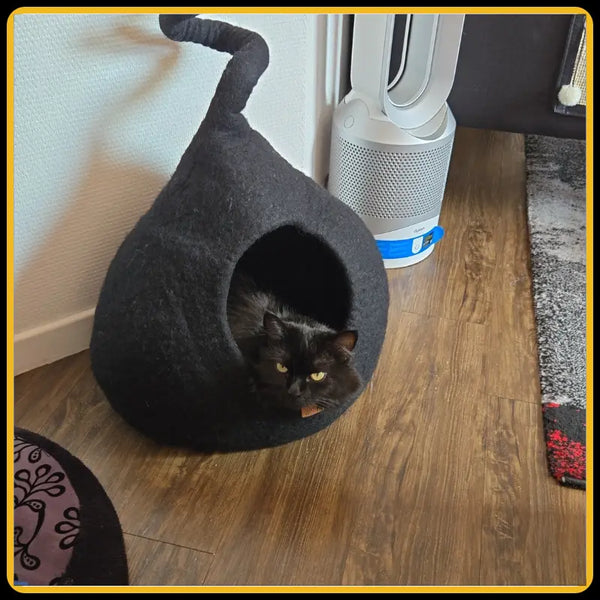
Ears flattened back, dilated pupils, low tail, tucked-up body, tendency to hide: when these signs occur repeatedly, your cat may be stressed. Read stressed cat: 12 signs to recognize and cat hiding: 7 reasons. Offering it a quiet refuge, such as a felted wool cave, helps it feel safe.
Frequently asked questions
How can I tell if my cat loves me?
It comes to you with its tail held upright, slowly blinks its eyes, rubs against you, sleeps near you or on you. See why my cat sleeps on me.
Why does my cat swish its tail when I pet it?
It is starting to become annoyed or overstimulated. Stop petting it before it scratches or bites.
My cat shows me its belly, then scratches me: why?
Showing its belly means it feels confident, not that it wants to be petted there. It is a sensitive area for most cats.
What does a slow blink mean?
It is a sign of relaxation and trust. Respond by slowly blinking your eyes: many cats react to it.
In summary
To understand your cat, never look at a single signal: observe the tail, ears, eyes, whiskers and posture together, in context. With a little practice, you will know when it wants to play, when it wants to be left alone and when it needs help.