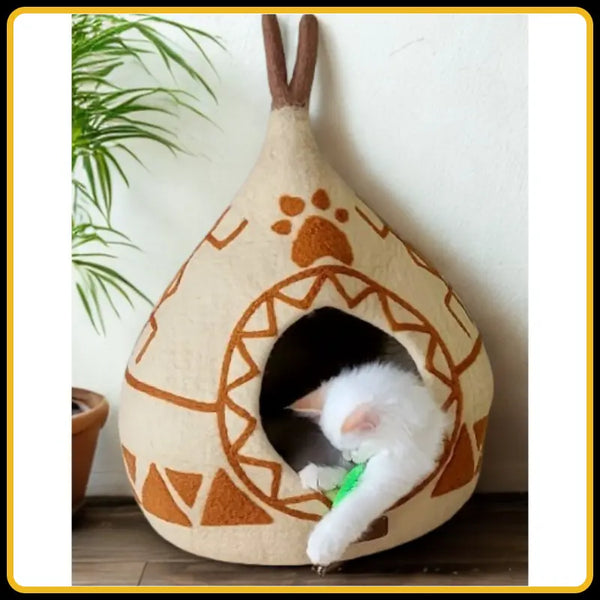
Why Your Cat Needs Shelter (Even If It Lives in an Apartment): The Science Behind the Protective Instinct
Why Does Your Cat Need Shelter? Have you ever wondered why your cat spends hours curled up in a cardboard box instead of on its luxurious €80 bed? Or why it always hides under the bed when guests arrive? The answer lies in a fundamental need ingrained in its DNA: a cat shelter isn't a whim, it's a deep psychological necessity. Let's delve into the fascinating world of feline psychology to understand why providing your companion with a suitable refuge can literally transform its mental well-being.
The Instinct of the Den: When Biology Meets Behavior
Cats are predators... and prey
Contrary to popular belief, domestic cats are not solely apex predators. In the wild, a medium-sized wild cat remains vulnerable to birds of prey, foxes, wild dogs, and even big cats. This biological reality has shaped a crucial survival behavior: the constant search for confined and secure spaces.
Studies in feline ethology conducted by Dr. John Bradshaw of the University of Bristol have shown that cats naturally spend 16 to 20 hours a day resting and sleeping. But be warned: sleeping doesn't mean feeling safe. A cat that sleeps uncovered remains in a state of partial alertness, its nervous system continuing to analyze potential threats. The result? Poor quality rest, high chronic stress, and, in the long run, behavioral problems.
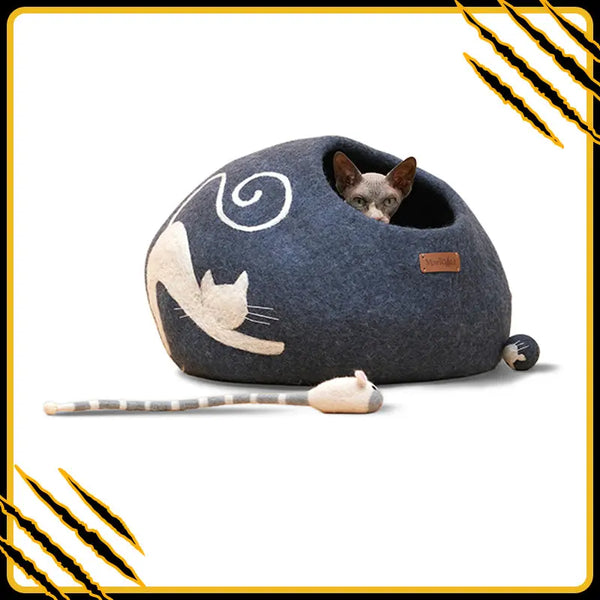
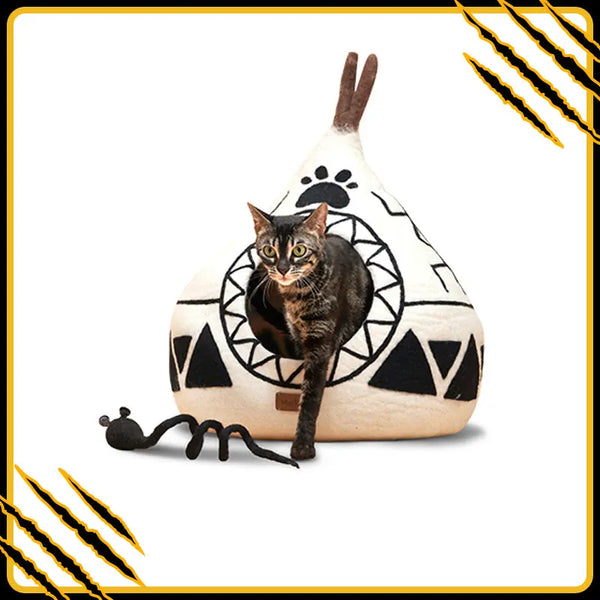
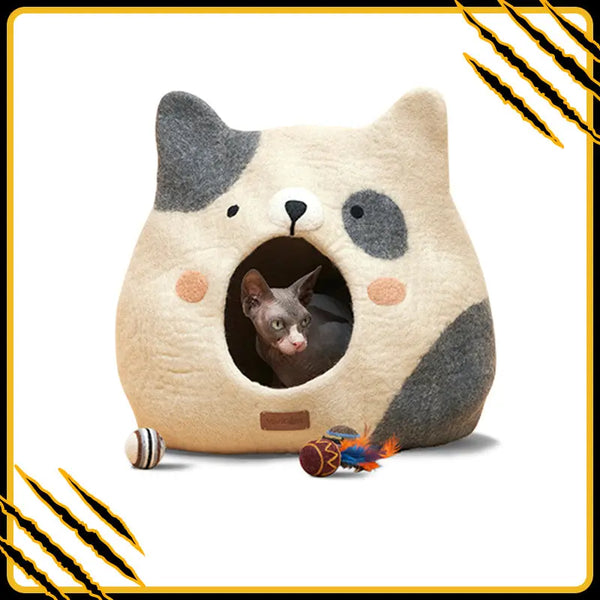
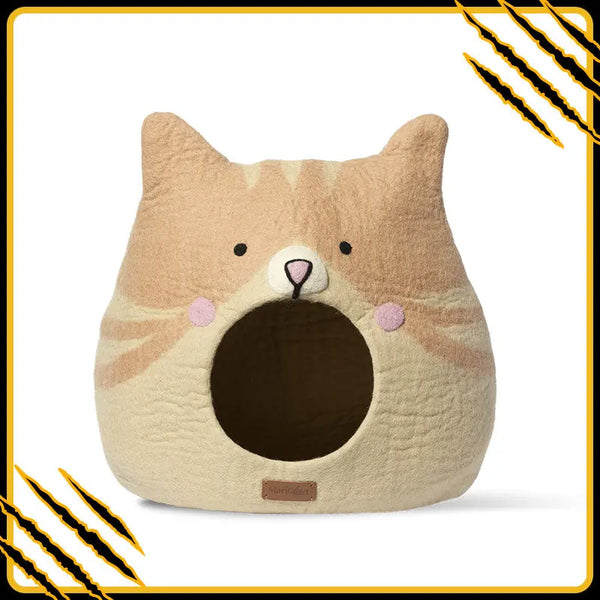
This is precisely where the vital importance of a proper cat shelter comes in. A cat cave or wool cat house is not just a decorative accessory: it's a therapeutic tool that allows your feline to achieve deep and truly restorative sleep.
The Phenomenon of “Soothing Compression”
Have you noticed that your cat always tries to squeeze into narrow spaces that fit its body? This behavior is explained by what specialists call "soothing compression" or "deep pressure therapy" in scientific literature.
When a cat curls up in a snug space, the walls exert gentle but constant pressure on its body. This tactile stimulation triggers the release of endorphins and oxytocin (the feel-good hormone) while reducing the production of cortisol (the stress hormone). It's exactly the same principle as weighted blankets used for human anxiety or swaddling techniques for babies.
A well-sized outdoor cat house or cat shelter naturally recreates this calming effect. The optimal dimensions? A space where the cat can turn around comfortably, but where the walls remain in light contact with its body when it curls up. Too large, the shelter loses its sense of security; too small, it becomes uncomfortable and anxiety-inducing.
The Silent Signs of Feline Stress: When Your Cat Is Calling for Help
Deciphering the Body Language of the Homeless Cat
Many owners are unaware that their cat suffers from chronic stress due to a lack of suitable safe spaces. Felines are masters at concealing their distress, a survival strategy inherited from their wild ancestors (showing weakness = becoming prey).
Here are the subtle behavioral indicators that reveal a cat lacks a secure cat shelter:
Constant hypervigilance : Does your cat always sleep in the "bread" position (paws tucked under its body, head raised) rather than in a relaxed position on its side? This positioning indicates that it remains alert even while resting, unable to reach deep sleep due to a lack of a secure environment.
Excessive grooming or bald patches : A stressed cat often develops repetitive grooming behaviors that can lead to areas of hair loss, particularly on the belly, flanks, and hind legs. This "overgrooming" is a self-soothing mechanism in response to environmental anxiety.
Avoidance of common areas : If your cat spends most of its time hiding under furniture, behind the sofa, or in the wardrobe, this is a major warning sign. It is desperately seeking refuge areas that it cannot find in the open spaces of your home.
Unpredictable defensive aggression : A cat that constantly feels vulnerable often develops disproportionate aggressive reactions. Sudden scratching during petting, attacks on ankles, hissing for no apparent reason: all are manifestations of a nervous system overstimulated by a lack of spatial security.
Appetite disturbances or inappropriate elimination : Chronic stress disrupts basic physiological functions. A cat without a suitable refuge may develop anorexia, bulimia, or begin urinating outside its litter box (anxious marking).
The Cardboard Box Test
Want to know if your cat is lacking safe havens? Try this simple but revealing test: place a medium-sized cardboard box (like a moving box) in your living room. If your cat settles in within 24 hours and spends several hours a day there, it's irrefutable proof that it was desperately seeking a secure shelter.
A Dutch study conducted at the Utrecht animal shelter followed two groups of newly arrived cats: one group had cardboard boxes, the other did not. The result was striking: the cats with boxes showed 60% lower stress levels and adapted twice as fast to their new environment. This experiment scientifically demonstrates the massive impact of a simple shelter on feline psychological well-being.
Feline Architecture: How to Design the Perfect Cat Shelter
The 5 Pillars of a Psychologically Optimal Refuge
Not all cat shelters are created equal. To maximize psychological benefits, a cat house must adhere to certain fundamental principles derived from behavioral research:
1. The Cave Effect: Unique Entrance and Controlled Visibility
In the wild, felines choose dens with a single opening they can monitor. This allows them to visually control approaches while knowing that no one can surprise them from behind. An ideal cat shelter replicates this configuration with a 15-18 cm diameter opening positioned to offer a view into the main room.
Exception: For multi-cat households or particularly anxious felines, a double opening can be beneficial by providing an "escape route" in case of conflict. However, the two openings should never be opposite each other (creating a draft and reducing the feeling of security) but rather adjacent at a 90° angle.
2. The Rule of Thirds: Precise Sizing for the Cocoon Effect
The perfect size for a cat cave is calculated according to the "rule of thirds" developed by feline behaviorists:
- Inner length : cat's length (nose to base of tail) + one third
- Interior width : width of the cat curled up in a ball + one third
- Interior height : height of the sitting cat + one third
This formula ensures that the shelter provides a soothing compression effect without causing discomfort. For an average-sized cat (4-5 kg), this corresponds to approximately 45x40x35 cm of interior space.
3. Sensory Materials: The Importance of Texture and Temperature
Cats possess exceptional tactile sensitivity, particularly developed in their paw pads and whiskers. The choice of material for an indoor or outdoor cat house directly impacts their psychological comfort:
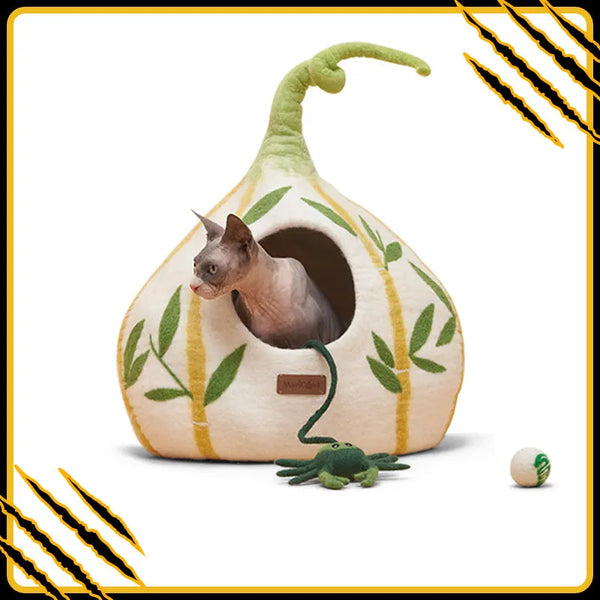
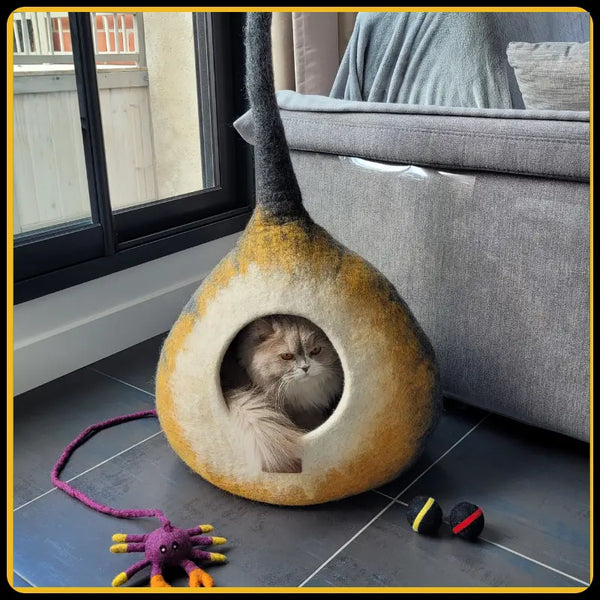
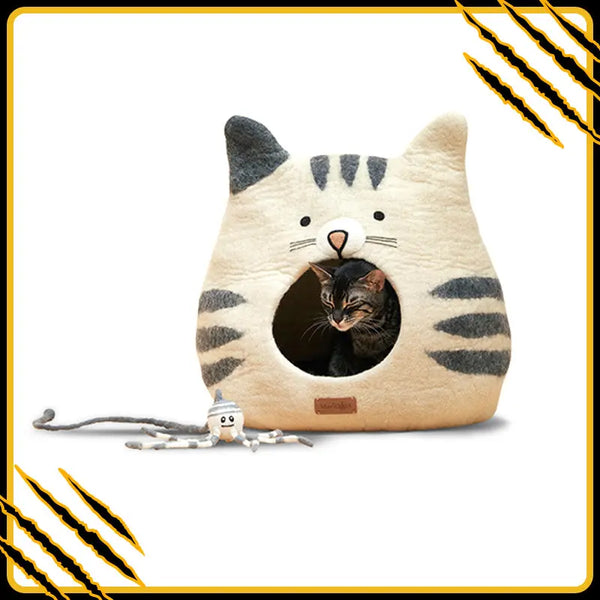
Natural felted wool : This material offers remarkable thermoregulatory properties (cool in summer, warm in winter) and a soft texture reminiscent of a mother's fur. Wool caves also positively stimulate "kneading" behavior (reminiscent of maternal feeding), a sign of well-being and deep relaxation.
Untreated raw wood : For outdoor cat shelters, wood offers natural insulation and absorbs feline pheromones, allowing the cat to psychologically claim its territory. Opt for cedar or pine for their natural antibacterial properties.
Absolutely avoid : synthetic fabrics that generate static electricity (unpleasant for sensitive whiskers), plastics that retain odors, and any chemically treated material whose odor would mask the cat's pheromone markings.
4. Strategic Positioning: The Theory of Graduated Security Zones
The location of your cat shelter is just as crucial as its design. Cats mentally organize their territory into graduated safety zones:
Maximum security zone (core territory) : This is where the main refuge should be located. Characteristics: quiet area away from frequented paths, visual protection on at least three sides, absence of harsh noises. Ideally elevated (1-1.5m above the ground) as height reinforces the feeling of territorial control.
Active vigilance zone (intermediate territory) : The area between the shelter and the activity zones. The cat must be able to observe this zone from the entrance of its shelter without being immediately visible from human passageways.
Social zone (periphery) : Spaces shared with humans. The shelter should NEVER be located directly in this zone, otherwise the cat will ignore it and not feel safe there.
A common mistake: placing the cat house in the living room in front of the television or near the front door. Guaranteed result: an unused shelter and a cat that will continue to hide under the bed.
5. Olfactory Enrichment: The Secret Weapon of Appropriation
A shelter truly becomes a cat's "territory" when it is imbued with its own pheromones. To accelerate this process of appropriation:
- Gently rub a clean cloth on your cat's cheeks (facial pheromone glands) and then on the inside walls of the shelter.
- Place inside an item of clothing you have recently worn (your scent will reassure the cat).
- Add a few sprigs of dried catnip (relaxing effect without overstimulation)
- Let the cat explore freely without forcing it to enter (respecting its choice reduces anxiety).
Case Studies: When Shelter Resolves Behavioral Problems
Luna's Story: Aggression Resolved Through Spatial Planning
Luna, a 3-year-old European Shorthair, was literally terrorizing her owners with unpredictable attacks. The classic diagnosis: a "temperamental" or "vicious" cat. The behavioral reality: Luna lived in a 25m² studio apartment without any suitable safe haven. Her only refuge was under the bed, a space where she felt trapped and from which she launched preemptive attacks out of fear.
Solution implemented: installation of three cat hideaways at different levels (floor, medium height, high height) in strategic corners of the apartment. Addition of a wool cave on the main shelf, offering a commanding view of the entire space.
Results after 3 weeks: complete disappearance of aggressive behavior; Luna spends 70% of her resting time in her elevated cave, from where she calmly observes her surroundings. Petting is possible again because she no longer feels constantly threatened.
The "Invisible" Cat Syndrome: Socialization through Security
Many owners complain of having a "ghost cat" that spends its days hiding and never interacts. This chronic avoidance behavior often reflects a dramatic lack of accessible and appropriate refuge spaces.
Rehabilitation protocol successfully tested on 40 "invisible" cats:
Phase 1 (Weeks 1-2) : Install a cat shelter in the cat's preferred hiding place (often the bedroom or a closet). The goal is not to change its behavior but to offer it a more comfortable alternative to its current hiding spot.
Phase 2 (Weeks 3-4) : Once the shelter is adopted, gradual movement (15-20 cm per day) towards a more social area while maintaining the safety criteria (height, visual protection).
Phase 3 (Weeks 5-8) : Introduction of positive activities near the shelter (play, treats, brushing) to create positive associations with human interactions in a safe environment.
Success rate: 85% of cats significantly increased their presence in common areas and their voluntary social interactions after 8 weeks.
The Multi-Cat Shelter: Managing Group Dynamics
The N+1 Rule: Preventing Territorial Conflicts
In a multi-cat household, competition for resources often creates tension. The golden rule of feline behavior: for every N cats, provide N+1 safe spaces. This over-provisioning ensures that no single cat can monopolize all the secure areas and prevent others from accessing them.
Optimal spatial configuration for 3 cats:
- 1 elevated cat niche (dominant cat's territory)
- 1 outdoor cat house on the balcony or terrace (decompression space)
- 1 cave in a quiet room (a refuge for the shyest cat)
- 1 additional cat house in an intermediate area
This distribution avoids the formation of "controlled zones" where a dominant cat would block access to essential resources (food, water, litter) by monopolizing passage points.
Identify the cat that truly needs a shelter
Not all cats exhibit the same level of urgency. Equipment priorities in a multi-cat household:
Top priority : The cat at the bottom of the social hierarchy, often the one who eats last, avoids others, or exhibits avoidance behaviors. This is the cat that will benefit most immediately from a safe haven space.
Secondary priority : Elderly or sick cats who need prolonged and quiet rest, away from the energetic stimulation of younger cats.
Tertiary priority : The dominant cat also benefits from a refuge, but usually high up (cat tree with closed platform) rather than on the ground.
Outdoor Shelters: The Extra Dimension of Protection
Why a Cat with Outdoor Access Needs Shelter EVEN MORE
Paradoxically, an outdoor cat requires even more shelters than an indoor cat. Outside, the threats are real and numerous: other territorial cats, unleashed dogs, inclement weather, vehicles, and unpredictable urban noises. An outdoor cat lives in a state of near-constant vigilance.
A strategically placed outdoor cat shelter offers:
Intermediate safety point : Between the house and the limits of the explored territory, allowing the cat to "recharge" psychologically before continuing its patrols.
Climate protection : Temperature fluctuations quickly exhaust a cat. An insulated shelter allows it to regulate its body temperature without expending excessive energy.
Emergency shelter : In the event of a confrontation with a predator or an aggressive fellow cat, the outdoor shelter can literally save the cat's life by offering it an immediate point of retreat.
Optimal Cat Garden Configuration
For a cat with access to a garden or terrace, the ideal solution is to create a "safety network" with several refuge points:
Main station : A sturdy and well-insulated outdoor cat house positioned in a sheltered corner of the garden, ideally elevated and against a wall or hedge.
Relay points : 2-3 simpler shelters (upside-down crates with openings, large empty planters) strategically dispersed to offer intermediate rest areas.
Secure observation area : An outdoor platform or shelf with a roof offering a commanding view of the territory. Cats spend more time observing than moving around; this area quickly becomes their favorite lookout post.
The €200 Mistake: Why So Many Shelters End Up Unused
The 7 Reasons Why Your Cat Ignores Its New Shelter
You've just invested in a gorgeous designer cat house and... it's just a useless decoration? You're not alone. Here are the most common mistakes that explain this rejection:
1. Too big, too small, or bad shape : An elongated rectangular shelter does not provide the same feeling of security as a rounded or oval shape that envelops the cat.
2. Persistent chemical odor : New plastics, paints, varnishes, or treatments release volatile compounds that irritate a cat's ultrasensitive sense of smell. Solution: Ventilate the shelter for 72 hours before introducing the cat.
3. Inappropriate location : Frequent traffic, proximity to noisy appliances, drafty area, too visible from social spaces.
4. Timing of introduction : Introducing a new shelter during a stressful period (moving house, arrival of a baby, renovations) is doomed to failure. The cat will associate the shelter with the surrounding stress.
5. Parental force : Physically forcing the cat into the shelter creates an immediate and lasting negative association. Patience is essential.
6. Lack of olfactory preparation : A "foreign" shelter without prior pheromonal impregnation remains an unknown, potentially threatening object.
7. Competition with a favorite informal shelter : If your cat has already adopted a cardboard box, a closet shelf, or the space under the sofa, you'll need to make the new shelter MORE attractive, not just equivalent.
The Gradual Introduction Protocol (PIP)
To maximize the adoption of a new cat shelter, follow this proven protocol:
Days 1-3: Passive Familiarization Phase
- Place the shelter in a medium-traffic area (neither too isolated nor too busy).
- Do not completely close the entrance if the shelter has a door
- Let the cat explore from a distance without intervention.
Days 4-7: Olfactory attraction phase
- Rub the inside with a cloth impregnated with cat facial pheromones
- Place some treats right at the entrance (not at the back).
- Add a favorite toy nearby
Days 8-14: Positive Encouragement Phase
- Play near the shelter to create positive associations.
- Reward verbally and with a treat any voluntary approach
- If the cat comes in on its own, don't react! Any attention might make it run away.
Day 15+: Strategic Movement Phase
- Once you have settled in, you can move the shelter very gradually (10-15 cm per day maximum) to its optimal final location.
Success rate with this protocol: 90% adoption within the first 3 weeks versus only 40% with direct introduction.
When Shelter Becomes Therapy: Applications in Veterinary Behavioral Medicine
Clinical Protocols Using Shelters
Veterinary behaviorists now systematically incorporate the creation of refuge spaces into their therapeutic protocols for various pathologies:
Generalized anxiety in cats : Standard prescription = 3-4 strategically placed shelters + temporary removal of stressful stimuli + synthetic calming pheromones. The cat shelter becomes a "therapeutic space" where the cat can recharge.
Redirected aggression : After a triggering event (a cat seen through a window, a loud noise), the cat may remain in a state of hyper-excitement for hours. A dark and quiet refuge speeds up the return to normal by reducing sensory stimuli.
Compulsive disorders : Repetitive behaviors (excessive grooming, continuous vocalization, frantic running) are often exacerbated by the lack of safe havens where the cat can "switch off." Adding suitable safe havens is an integral part of behavioral therapy.
Post-operative period : A convalescent cat needs a quiet and cozy refuge to recover undisturbed by other animals or children. A dedicated shelter facilitates healing by reducing stress.
The "Temporary Sanctuary": A Crisis Management Technique
When faced with a traumatic event (moving house, the arrival of a baby, renovations, a new pet), behaviorists recommend the "temporary sanctuary" technique:
Setup: A quiet room equipped with a comfortable cat shelter, water, food, litter, and toys. The cat stays there for 3-7 days to adjust to the changes taking place in the rest of the home.
Advantages: Drastic reduction of stress, prevention of chronic avoidance behaviors, facilitation of gradual adaptation to the new environment.
Once the cat has stabilized in its sanctuary, a gradual reintroduction to the modified spaces is carried out, while maintaining its refuge shelter as a permanent point of security.
Conclusion: The Shelter, an Invisible Pillar of Feline Well-being
The importance of a suitable cat shelter goes far beyond mere physical comfort. It's a fundamental psychological need, ingrained in the DNA of our feline companions after millions of years of evolution. Providing your cat with a well-designed and properly positioned cat house, cat kennel, or outdoor cat shelter gives them the keys to a peaceful, balanced, and fulfilling life.
The signs are right there in front of you: the cat that always sleeps tense, the one that constantly hides, the one that jumps at the slightest noise. They aren't "weird," "fearful," or "temperamental." They simply lack something essential to their psychological well-being: a suitable refuge where they feel completely safe.
The good news? Unlike many complex behavioral problems, this one has a simple, immediate, and accessible solution. Whether you opt for a handcrafted felted wool cat shelter, a DIY construction, or a high-end commercial model, the key is to respect your companion's biological and psychological needs.
Look at your cat differently today. Observe where it retreats, how it sleeps, how it reacts to stimuli. These observations will guide you to the ideal refuge that might transform its life. Because a cat that feels safe is a cat that can finally relax, play, interact, and offer you the happiest version of itself.