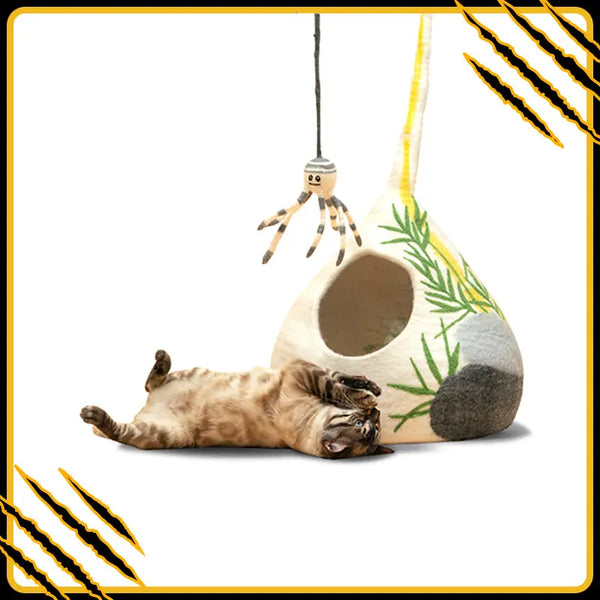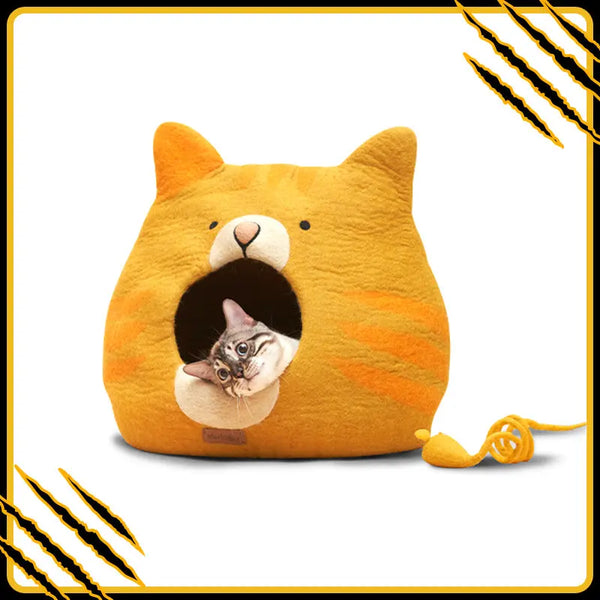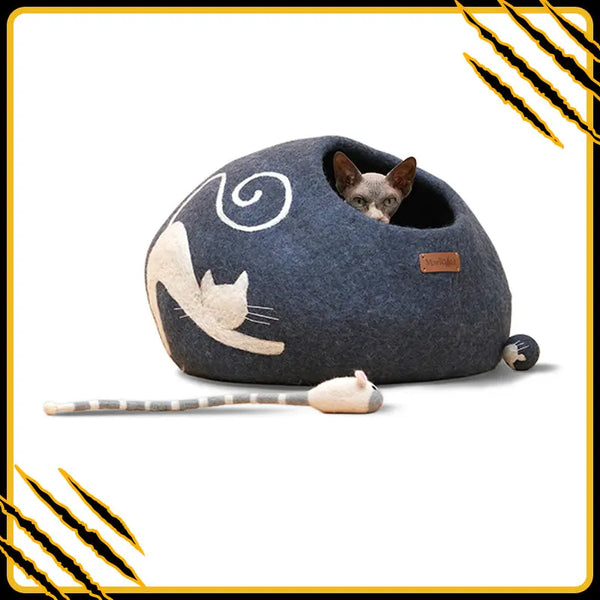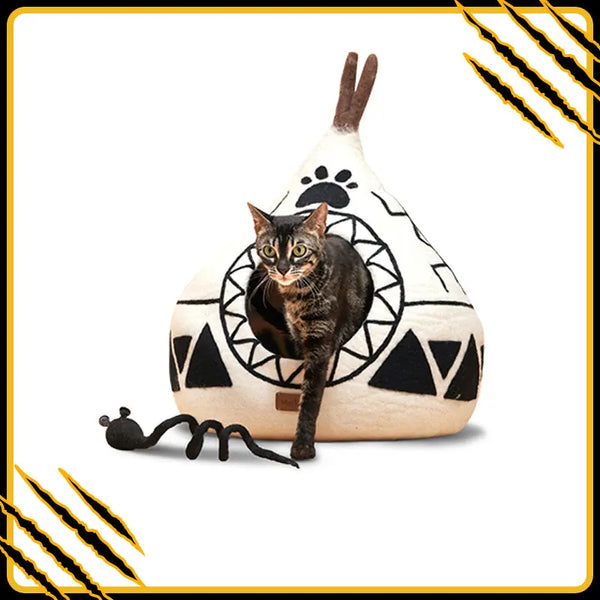

Cave, house, cubby, teepee, pod: choosing a cat bed seems simple, until you have to make a choice. The right model depends first on one question: will your cat use it indoors or outdoors? Then come size, material, stability, and location. This buying guide compares the main types of cat beds and gives you the criteria for choosing, without getting lost in product descriptions.
Indoor bed or outdoor bed: two different needs
- Indoors, the bed is a refuge: a closed, quiet, and warm place where the cat can go to sleep or get away. Comfort, material, and a cocoon-like effect are paramount.
- Outdoors, the bed is protection: against rain, wind, and cold. Waterproofing, insulation, and weather resistance are paramount.
One model rarely does both well. A wool or fabric cave is not made for the rain, and a plastic cubby is uninviting in a living room.
Comparison of cat bed types
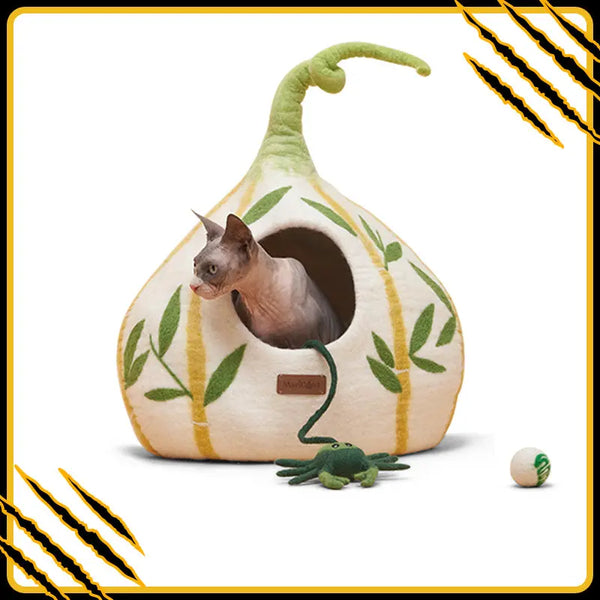
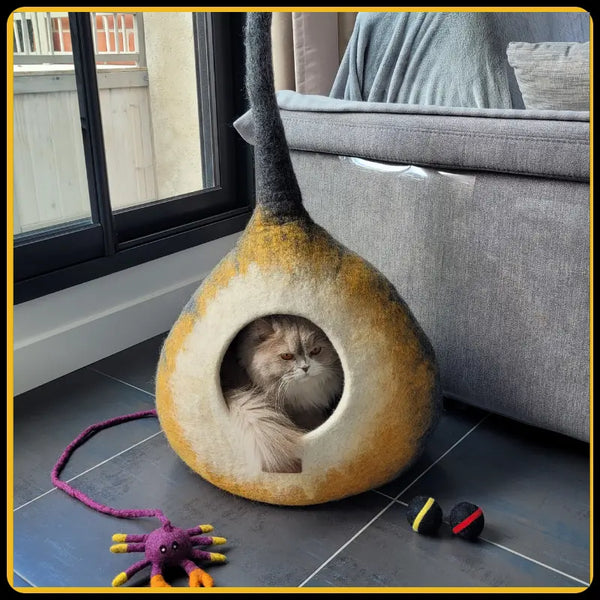
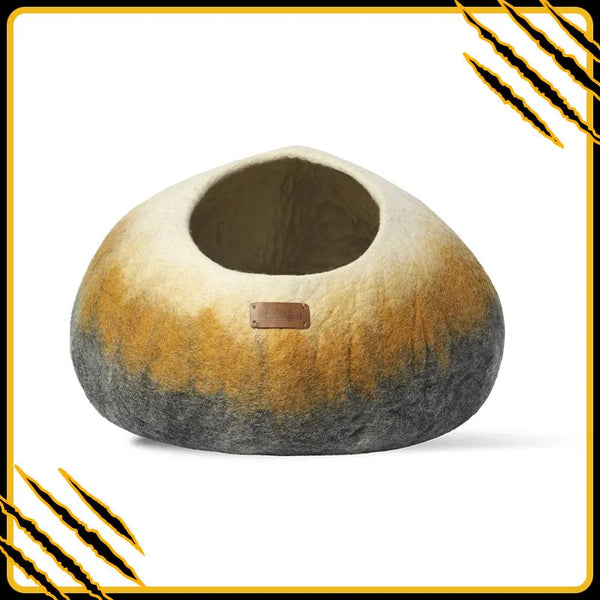
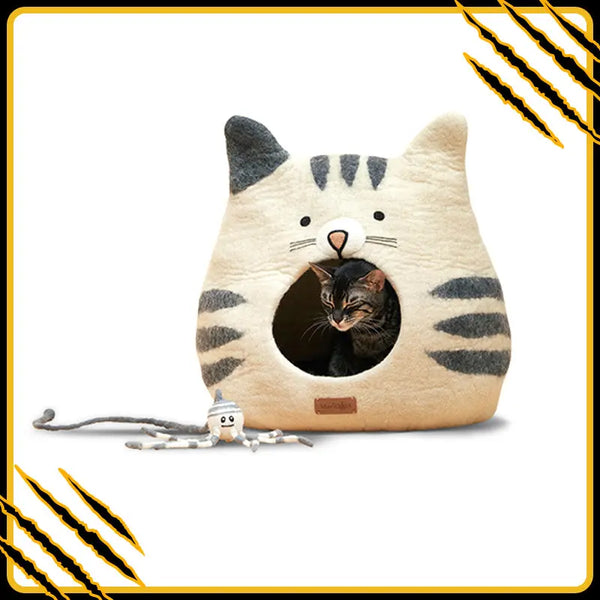
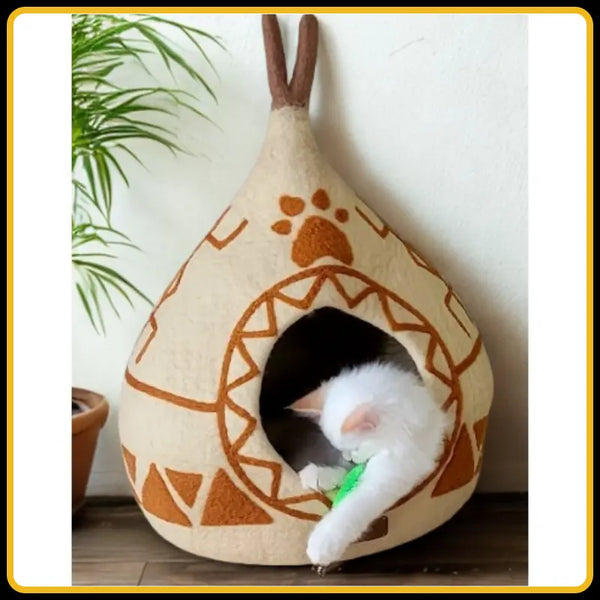
- The cat cave (indoor): closed shape, single opening, solid walls. The closest to the need for a den. Ideal for timid, chilly, recently adopted cats, or cats living in a busy household.
- The cat house (indoor): closed but taller, with a wider entrance. A good compromise for larger cats and older cats who find it harder to enter, like our Potir cat house.
- The teepee (indoor): wide opening, very airy, less enveloping. For confident cats and daytime use.
- The basket or cushion (indoor): open, without a refuge effect. Perfect as a secondary bed, close to you. See our felted wool cushions.
- The outdoor cubby or shed: treated wood, thick plastic, or resin, with insulation and a raised floor. For cats that live outdoors or stray cats. For winter, follow our guide to outdoor cat beds in winter.
Criterion no. 1: the right size
This is the most common mistake: choosing a large one "so they can be comfortable". A bed that is too large loses the cocoon effect and does not retain heat well, because the cat can no longer feel the walls and cannot warm the air inside. Conversely, a bed that is too small becomes uncomfortable.
- Indoors: the cat must be able to curl up into a ball and turn around, no more. Measure it from the nose to the base of the tail and compare it with the model's internal dimensions.
- Outdoors: for one or two cats, approximately 40 to 50 cm on each side and 35 to 40 cm high, with an opening of about 15 cm.
- Large cats: our caves are suitable for cats up to 9 kg. For a heavier adult Maine Coon, prefer a house with a large entrance or a large-format cushion.
Criterion no. 2: the material
Felted wool
- Pros: retains the cat's heat, remains breathable, handles moisture well (the fiber absorbs some without feeling wet), and absorbs the cat's scent. Dense felted wool stands on its own and does not sag.
- Cons: more expensive, hand-washed in cold or lukewarm water, for indoor use only.
Fabric
- Pros: affordable price, wide choice of patterns, often machine washable.
- Cons: soft models sag over time and lose their refuge effect; synthetic fabrics retain odors more and insulate less well.
Plastic
- Pros: very easy to clean, resistant, suitable for outdoors.
- Cons: cold to the touch and poorly insulating without padding; not very pleasant as an indoor bed.
Wood
- Pros: insulating, robust, attractive in the garden.
- Cons: requires regular treatment (stain or non-toxic oil for animals) and is heavy.
To learn more about wool, read why your cat prefers a cardboard box to its bed.
Criterion no. 3: stability and sturdiness
A cat feels safe in a bed that does not move or collapse when it enters. Indoors, check that the walls stand on their own: a simple indicator is weight, a good dense felt cave is surprisingly heavy for its size. Outdoors, the bed must be heavy enough or secured to resist the wind, and perfectly waterproof: a bed that lets water in is worse than no bed at all.
Criterion no. 4: maintenance
- Wool cave: vacuum cleaner or brush for hair, localized cleaning with cold water, full hand washing from time to time. Our wool cave care guide details each step.
- Fabric: check that the cover is removable and machine washable.
- Outdoor bed: prefer a removable roof to change the straw without turning the bed over, and smooth surfaces that are easy to clean.
Criterion no. 5: your cat's profile
- Timid or recently adopted cat: a closed cave with a single opening.
- Chilly or senior cat: a warm material like wool, a low entrance. For joint pain, see our article on the orthopedic cat cushion.
- Confident cat: a teepee or open basket may be enough, in addition to a refuge.
- Several cats: one bed per cat, distributed in different rooms; a single shared refuge creates tension.
- Outdoor cat: an isolated, raised cubby filled with straw, never a blanket that retains moisture.
Criterion no. 6: aesthetics
An indoor bed is part of your decor and will remain in view for years. Choose a color and shape that blend into your room: a bed you like to look at is a bed you will leave in the right place, and that is what matters for your cat. For ideas, read how to integrate a cat cave into your decor.
Placing the bed properly
- Indoors: in a quiet corner, out of the way, against a wall with the opening facing the room, away from the litter box and food bowls.
- Outdoors: opening with its back to the prevailing wind, against a wall or under an awning, raised by at least 10 cm on a pallet or concrete blocks.
To get your cat to use the bed: place it near where your cat already sleeps, put a piece of clothing you have worn and a few treats inside, and never force it to enter. Some cats settle in the same day, others take two or three weeks.
Make or buy?
For an outdoor bed, a homemade solution (polystyrene cooler, insulated double plastic tub) costs little and works very well: see our guide to making a cat bed. For indoors, a cardboard box can last a few weeks, but a quality cave offers incomparable comfort and durability.
Frequently asked questions
Will my cat use the bed?
Most cats adopt a well-placed bed of the right size. Give it time: two to three weeks of adjustment is normal.
Can I use a dog cubby?
It is generally too large to retain heat. Reduce the internal space with insulating panels, or place a small insulated box inside.
Can a wool cave go outside?
Only in a fully covered and dry space (veranda, garage, garden shed), never exposed to rain or snow.
Does an outdoor bed need heating?
Rarely in France: a small, insulated bed filled with straw is enough in most regions. Heating is only useful in cases of intense and prolonged cold, with equipment designed for animals and for outdoors.
Our MariGold cat caves
- Designed in France, hand-felted by our partner artisans, each piece is unique.
- Made from 100% sheep's wool, without plastic, glue, or frame: the shape is held by the density of the felt.
- Suitable for cats up to 9 kg.
- Stocked in France and shipped quickly.
- Covered by our 100-day cat adoption guarantee: if your cat does not adopt it, you will be refunded.