
Does your cat sleep on the radiator, on the internet box, or in the only patch of sunlight in the living room? Does it curl up tightly and snuggle up to you at night? This isn't just an endearing habit: it's often a sign that it's cold. A cat doesn't complain about the cold, it moves. Here's how to recognize a cat that is cold, which cats are most exposed, and 9 simple solutions to warm it up at night.
Why your cat is cold, even in a heated home
We set our homes to our own comfort, around 19 or 20 °C. However, the cat's thermal comfort zone, the range where its body needs to make no effort to stay at its normal temperature (around 38.5 °C), is significantly higher, around 30 °C.
In your living room, your cat is therefore not in danger, but it is constantly compensating. It spends its day looking for the few degrees it lacks, and at night, when the heating goes down, this need increases.
The 7 signs of a cat that is cold
- It sleeps curled up tightly, tail wrapped around its body, paws tucked in, muzzle buried. A cat that is thermally comfortable sprawls on its side. This is the most reliable and easiest sign to observe.
- It migrates towards heat sources: radiator, computer, top of the refrigerator, patch of sunlight, and you. If it changes places throughout the day following warm objects, it is dealing with a lack of heat.
- It sleeps longer: immobility limits heat loss.
- Its extremities are cold: the tips of its ears, paw pads, and the end of its tail are distinctly cool to the touch.
- Its fur is slightly puffed up: it raises its coat to trap a layer of insulating air, without fear or aggression.
- It slips under things: blanket, throw, cushions, ajar closet. It is looking for a small space that it can warm itself.
- It moves and plays less. In an older cat, the cold also accentuates stiffness: it jumps less high, hesitates in front of the sofa.
One or two signs prove nothing. Four or five together in the middle of winter, yes. However, beware: lethargy, increased sleep, and loss of appetite are also the first signs of many illnesses. If your cat's behavior changes significantly and the cold does not explain it, consult your veterinarian.
The cats most sensitive to the cold
- Kittens: their thermoregulation is still immature, they cool down quickly.
- Older cats: less muscle mass, less efficient circulation, often arthritis.
- Thin, sick, or convalescing cats: little insulating fat, weakened regulation.
- Short-haired or hairless breeds: Siamese, Oriental, Devon Rex, and especially Sphynx.
- Long-haired cats are not invulnerable: their undercoat loses its effectiveness if it is damp or matted.
9 solutions to warm your cat at night
1. Offer it an enclosed bed
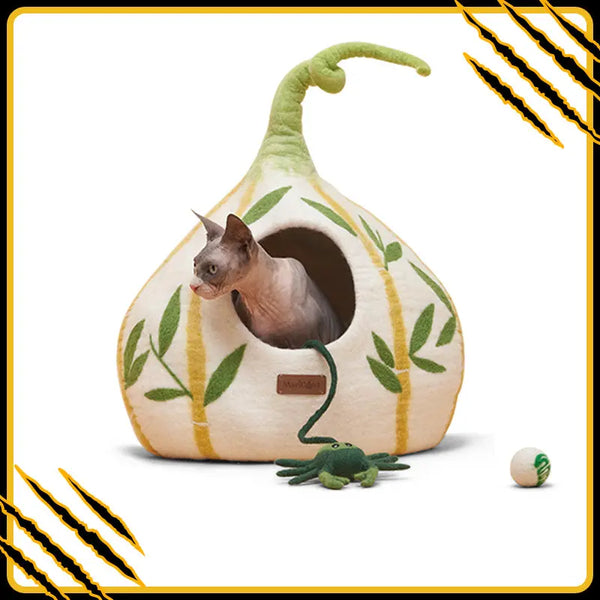
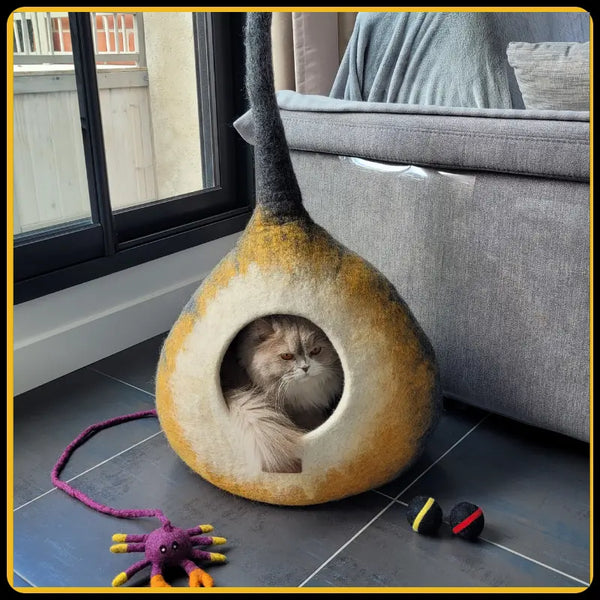
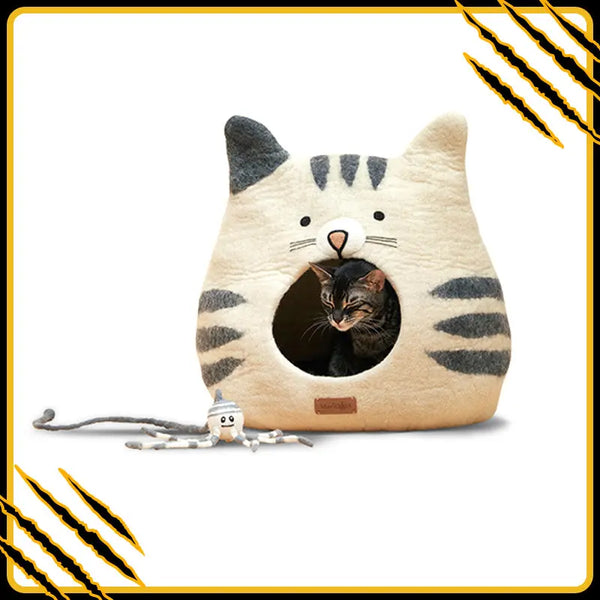
This is the decisive point. In an open basket, the heat given off by the cat dissipates immediately. In an enclosed space with solid walls, it stays: the cat warms its own shelter in a few minutes, then conserves it. It is not necessary to heat the entire room to 30 °C: it is enough to give it a place where it can reach this temperature.
2. Choose an insulating material
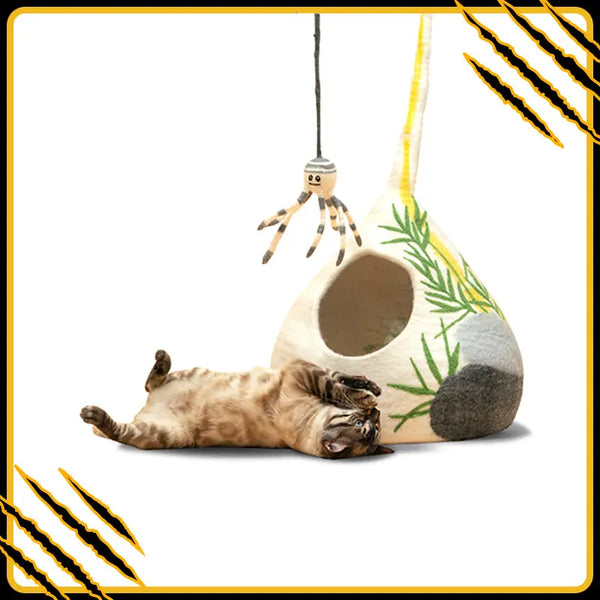
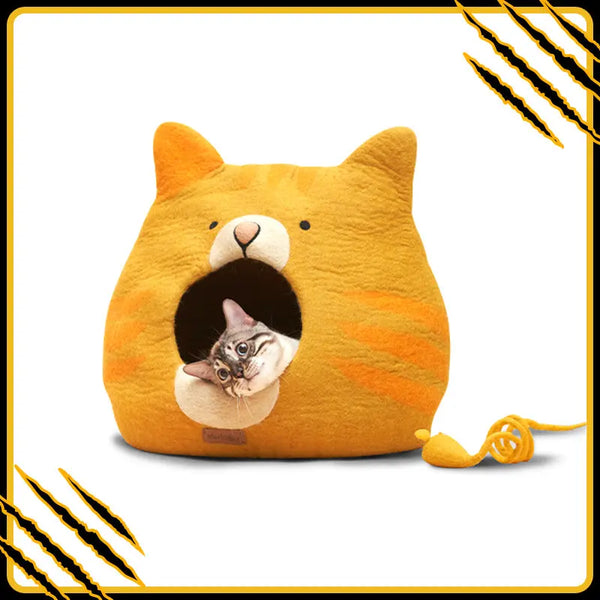
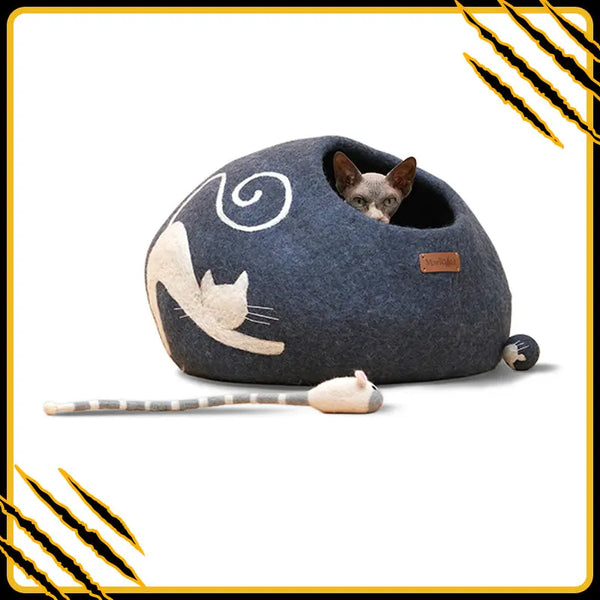
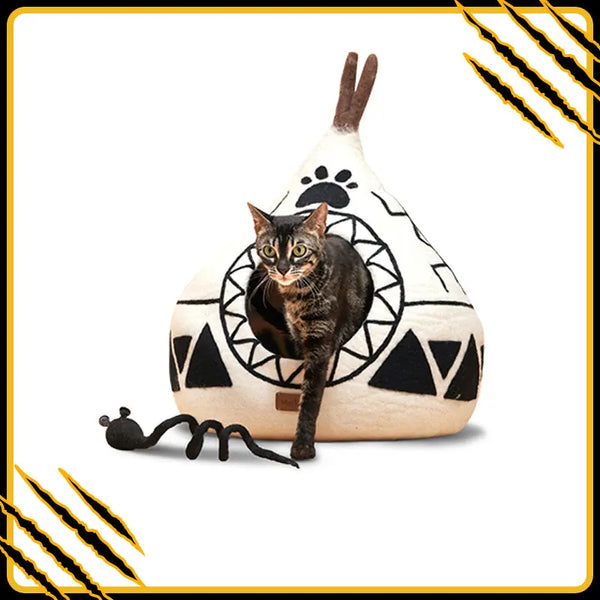
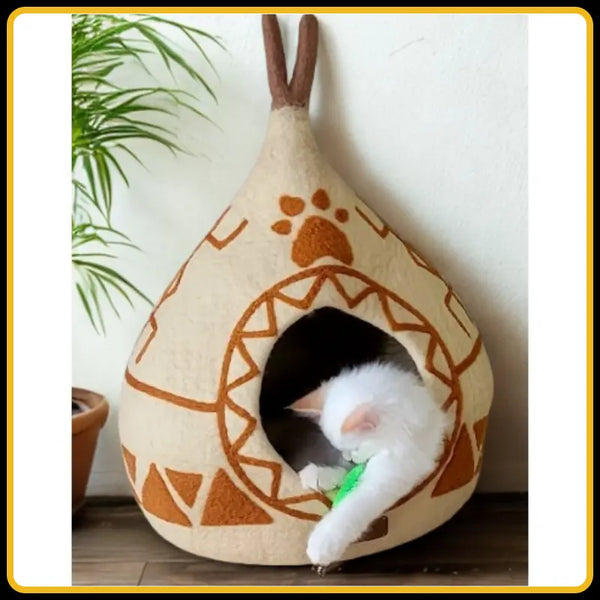
Felted wool traps air between its fibers, making it a natural insulator. It absorbs part of the moisture without giving a sensation of cold to the touch, where a synthetic fabric can retain condensation. This is the principle of our felted sheep's wool caves and houses. To understand why so many cats prefer an enclosed space, read why your cat prefers a cardboard box to its basket.
3. Elevate the bed
The floor is the coldest area of a room, and tile or parquet absorbs body heat through contact. Ten to twenty centimeters of height are enough: a stool, a shelf, a low cabinet. Failing that, slide a thick rug under the bed.
4. Place it away from drafts
Away from windows, doors, and passages. Tip: place your hand for a few minutes in the chosen spot. If you feel a draft, your cat does too.
5. Near a heat source, but not touching
A bed placed against a radiator alternates between overheating and sudden cooling when the heating turns off, and dries out the air. Keep a reasonable distance.
6. Multiply hot spots
A cat moves its bed according to the time and sunlight. Provide two or three areas: an enclosed refuge in a quiet corner, a wool felt cushion on a windowsill exposed to the morning sun, a third spot near you in the evening.
7. Add a blanket it can burrow into
Many cats like to bury themselves to create a microclimate. Leave a soft blanket available, in or next to its bed, and let it choose.
8. Keep a stable temperature at night
Rather than turning off the heating, leave it in reduced mode and close the shutters and curtains at nightfall: windows are among the main sources of heat loss.
9. Leave your door open
If your cat is cold, it will come to snuggle up to you. If you have several cats, they will often sleep together. This is normal behavior.
The false good ideas
- The classic hot water bottle: risk of burn by prolonged contact, a sleeping cat will not move away.
- Low-end heated mats, without a thermostat or automatic shut-off. If you use one, choose a model designed for animals, with a protected cable.
- Cat clothes: except for a veterinarian's advice (hairless cat, convalescence), they stress most cats and hinder their movements.
- Turn up all the heating: expensive and inefficient, an enclosed and insulated bed does better.
Older and arthritic cats
The cold accentuates stiffness and joint discomfort. Offer a thick bed, easy to access (without jumping), in the warmest room. See our article on the orthopedic cushion for arthritic cats and our tips for arranging the home of a senior cat.
And cats that go outside?
A cat with free access outside generally handles the cold well, provided it can come in. The real danger is the cat stuck outside. In extreme cold, limit outings at night, and check under the hood of your car before starting: warm engines attract cats. For cats that live outside, follow our guide to the outdoor cat shelter in winter.
When to consult a veterinarian
Consult quickly if your cat trembles even when warm, becomes very lethargic, refuses to eat, or if its extremities remain very cold: this could be hypothermia or an underlying illness.
Frequently asked questions
At what temperature does a cat get cold?
Its comfort zone is around 30 °C, well above our interiors. At 19-20 °C, it is not in danger, but it looks for heat sources.
How to know if my cat is cold at night?
It sleeps curled up tightly, tries to slip under the blanket or against you, and its ears and paw pads are cool to the touch.
Does a cat need a heated mat?
Rarely. An enclosed, insulated, and elevated bed is usually enough. If you use one, choose a model designed for animals, with a thermostat.
In summary
- A cat gets cold long before us: its comfort zone is around 30 °C.
- Observe the curled-up posture and the migration towards heat sources.
- The best solution is not to heat the room, but to offer it an enclosed, insulated, and elevated bed.